
Facilitated Diffusion
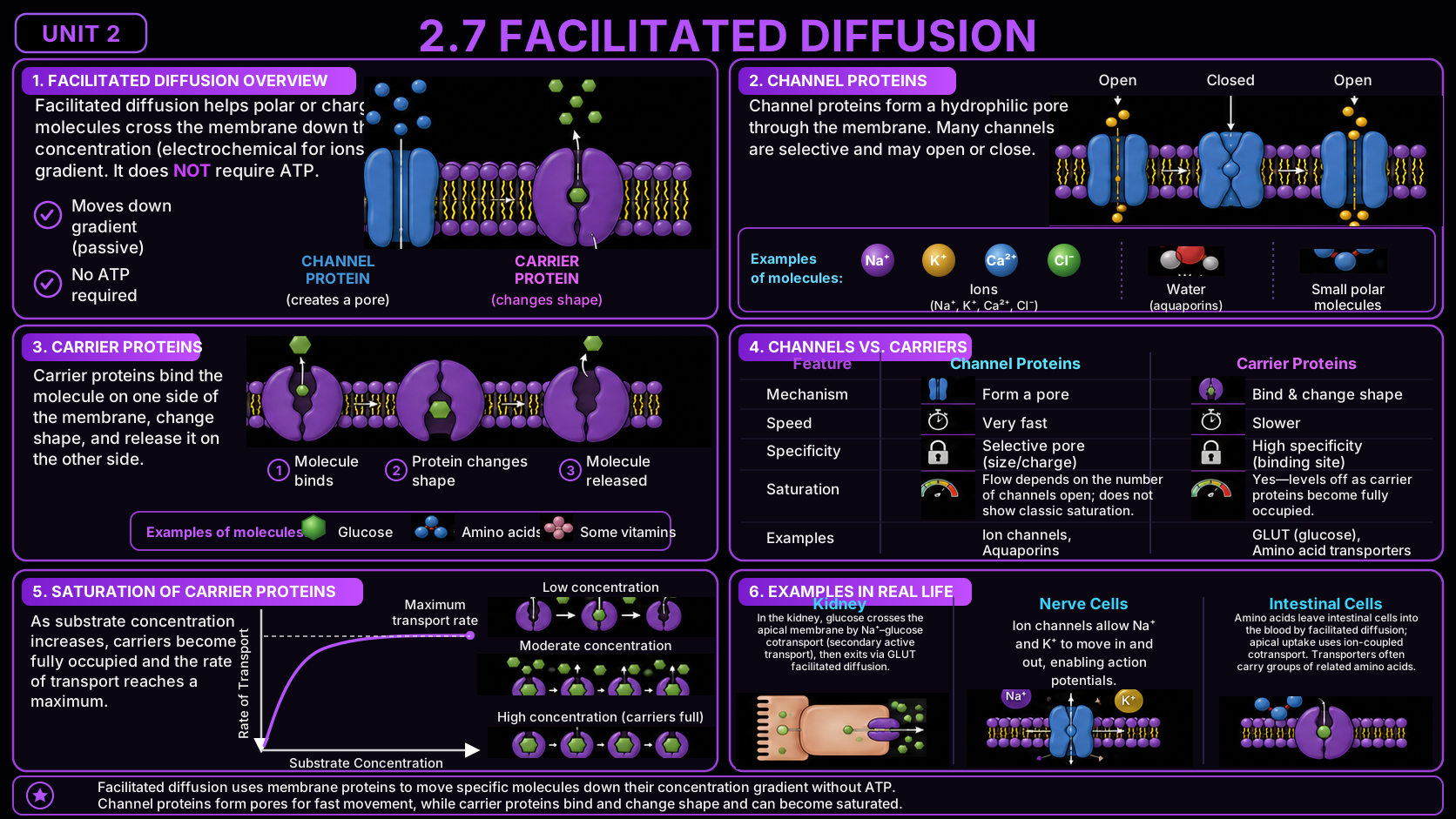
The phospholipid bilayer is a barrier by design: its hydrophobic core lets small, nonpolar molecules slip through, but it turns back the polar and charged solutes a cell depends on. Glucose, amino acids, and ions like Na⁺ and K⁺ cannot cross the oily interior on their own. Facilitated diffusion is how they get through anyway — membrane transport proteins give these solutes a hydrophilic path across, and the solutes still move down their concentration or electrochemical gradient. No energy is spent; the protein only opens a route the gradient was already pushing along.
Two kinds of protein do this work. A channel protein forms a water-filled pore — often gated, and often exquisitely selective, like an aquaporin passing water or an ion channel passing one species of ion — and solutes flow through in a stream. A carrier protein binds its solute on one side, changes shape, and releases it on the other, cycling one load at a time. Channels are fast and open; carriers are selective and slower, saturating when every binding site is full. Both move solutes the same direction the gradient dictates, and both do it without ATP.
Interactive · Channel & Carrier
Watch a solute cross the membrane two ways: streaming through an open channel, or riding a carrier that binds, flips, and releases. Set the gradient and see which direction the flow runs — and confirm no energy is spent either way.
Channel & Carrier · Open the full sandbox →The common mistake here is confusing facilitated diffusion with active transport. Because a protein is involved, students assume energy must be too — but a transport protein is not a pump. Facilitated diffusion is passive: it runs on the gradient alone and stops at equilibrium. Active transport is the opposite case — it uses ATP to move solutes against their gradient (U2-BIO11), the way the sodium-potassium pump does. Watch for the two traps this topic drills: treating carrier-mediated transport as active just because a protein binds the solute, and assuming any protein-assisted crossing must cost energy (U2-BIO11) — and reading the equilibrium it settles at as motion stopping, when the carrier keeps shuttling both ways and only the net flux is zero (U2-BIO2). Ask which way the gradient points — if the solute is moving down it, no ATP is required.
The work
3 ways in · any order
Lesson
Facilitated Diffusion
›
Polar and charged solutes cross the membrane through channel and carrier proteins, moving down their gradient without ATP. The lesson walks the ways students fold facilitated diffusion into active transport once a protein is involved, then closes with a ten-scenario applet: decide for each crossing whether energy is required and why the gradient, not the protein, is what settles it.
Diagnostic
10-item topic check
›
Ten items on facilitated diffusion (U2-BIO2, U2-BIO11): distinguishing channel from carrier proteins, reading which way a gradient drives the flow, and catching the moments where protein-assisted transport gets mistaken for active transport. Take it cold to surface which links are still broken, or after the lesson to confirm they hold.
Targeted Practice
Drill a single misconception
›
Pick one of the failure modes you missed and drill it on its own. The round is adaptive: two correct in a row clears the misconception and moves you to the next.