 Mistake Master
Facilitated diffusion
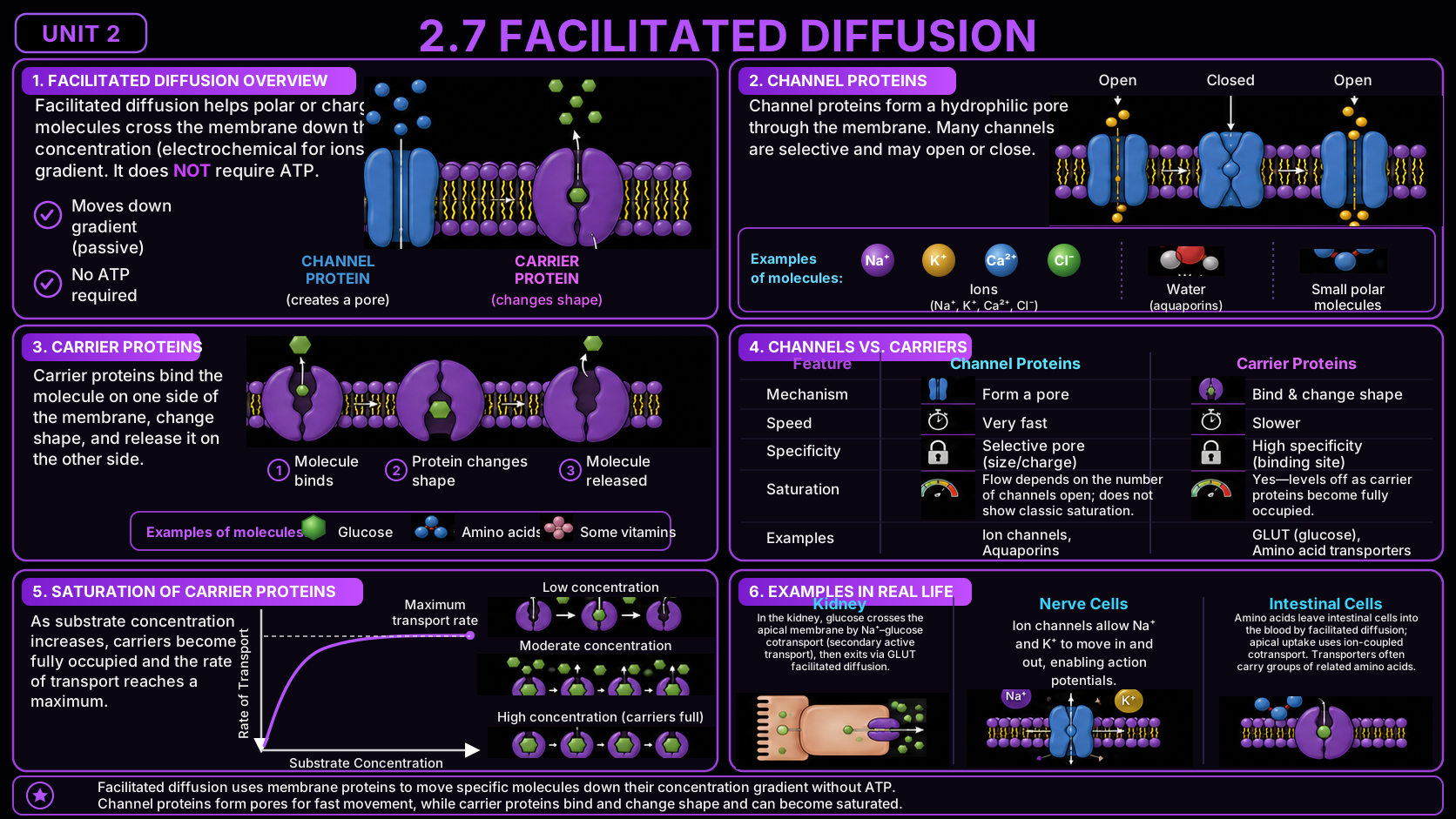
Small nonpolar molecules slip straight through the membrane's oily core, but polar and charged solutes — ions, glucose, amino acids — cannot. They get across through protein tunnels and shuttles: channels that form a pore and carriers that change shape to ferry a solute through. The crucial thing to hold onto is that this help is free: facilitated diffusion is still passive transport, always down the concentration gradient and never spending ATP. The protein sets the path; the gradient does the pushing.
§1
The one big idea: helped, but still passive.
▸
The whole topic rests on a single principle: facilitated diffusion moves a solute across the membrane with the help of a protein, but that help is entirely passive. The solute still travels down its concentration gradient — from where it is crowded toward where it is scarce — and the cell spends no ATP to make it happen. The word “facilitated” means eased along a path, not pushed uphill.
Why is a protein needed at all? The membrane's interior is a greasy layer of phospholipid tails. Small nonpolar molecules dissolve into that layer and slip through on their own (that is simple diffusion). But polar and charged solutes — ions like Na⁺ and K⁺, and larger polar molecules like glucose — are repelled by the oily core and can't cross unaided. A membrane protein gives them a route that avoids the greasy interior.
So the protein supplies the path, and the gradient supplies the push. Because the drive comes from the gradient rather than from the cell, no energy is burned. Hold those two facts together — protein-assisted and passive — and the rest of the topic follows.
§2
Two kinds of helper: channels and carriers.
▸
Facilitated diffusion runs through two different sorts of transport protein. Both are passive and both move solute down the gradient — they just do it in different ways.
- Channel proteins — open tunnels through the membrane. A channel forms a hydrophilic pore that spans the bilayer, so a specific solute can flow straight through without touching the greasy interior. Ion channels are the classic case: they let ions like Na⁺, K⁺, or Cl⁻ stream across very quickly. The pore just provides the opening — the gradient decides which way solute flows.
- Carrier proteins — shuttles that change shape. A carrier binds its solute on one side of the membrane, then changes shape to release it on the other side. The glucose transporter (GLUT) works this way. Carriers are more selective and slower than channels because each cycle handles a load and resets, but they are still passive — the shape change is powered by binding, not by ATP.
- Gated channels — pores that open on cue. Many channels are gated: they open or close in response to a signal (a voltage change or a bound molecule). Gating controls when the pore is open, but once open, solute still moves passively down its gradient. A gate is a switch, not a pump.
The common thread: whether it is an open pore or a shape-changing shuttle, the protein only supplies a route across the membrane. Neither one drives the solute — the concentration gradient always does.
§3
The terms you'll meet.
▸
Quick reference card. Each term ties back to the same idea — a protein supplies the route, the gradient supplies the push, and no ATP is spent.
§4
No ATP, and it ends at dynamic equilibrium.
▸
Two ideas separate facilitated diffusion from active transport and from the common misreadings of equilibrium. Get both and you can handle almost any question on this topic.
Passive means no ATP — the protein doesn't change that. It is tempting to think that because a protein is doing work, the cell must be paying for it. It isn't. The energy that moves the solute comes from the concentration gradient, which was already there. The transport protein is just a doorway; opening a door doesn't cost the cell fuel. This is the single biggest trap on the topic: facilitated diffusion is passive, full stop, even though it uses a protein.
Contrast with active transport. Active transport is the one that spends ATP, and it does so precisely because it goes the wrong way — against the gradient, from low concentration to high. If a solute is moving down its gradient, the process is passive whether or not a protein is involved. The direction relative to the gradient, not the presence of a protein, tells you whether ATP is required.
Where it ends: dynamic equilibrium. Facilitated diffusion runs until the solute is equally concentrated on both sides. But “equilibrium” does not mean the solute freezes in place. Individual molecules keep crossing the membrane in both directions — it's just that the rate one way now equals the rate the other way, so there is no net change. Zero net movement, plenty of actual movement. That is what dynamic means.
Reading a scenario. When a problem describes a solute crossing through a protein, ask two questions: which way is it going relative to the gradient (down = passive, no ATP), and has it evened out yet (if so, movement continues both ways with no net flux). Those two checks resolve most of the confusion on this topic.
§5
3 mistakes that cost real points.
▸
“Facilitated diffusion uses a protein, so it must use ATP.”
This is the signature misconception of the topic (BIO11). Students see a transport protein and assume the cell is paying energy to run it — or, flipped around, they think “passive” transport still needs a little energy. Neither is true. The push comes from the concentration gradient, which is already there; the protein just opens a path. Facilitated diffusion is passive and spends no ATP.
Fix. Decide by direction, not by whether a protein is present. Down the gradient (high → low) = passive, no ATP. Only transport that goes against the gradient (active transport) spends ATP.
“Once the solute reaches equilibrium, all movement stops.”
This is the equilibrium misconception (BIO2). At equilibrium the concentrations are equal, so students picture the solute sitting still. But molecules never stop moving — they keep crossing the membrane in both directions. What has become zero is the net flow, because the rate each way is now the same. Equal rates, not no motion.
Fix. Read “equilibrium” as dynamic: individual molecules still cross constantly; only the net change is zero. If a question implies motion halts, it's wrong.
“A carrier protein 'grabs and pumps,' so it must be active transport.”
Carriers change shape and handle their solute more deliberately than an open channel, and that makes them look like little pumps — so students tag them as active transport (a mix of BIO11). But a carrier doing facilitated diffusion still moves solute down the gradient, and the shape change is powered by binding, not by ATP. Being a carrier says nothing about whether ATP is used; direction does.
Fix. Channel vs. carrier is about how the solute crosses; passive vs. active is about which way relative to the gradient. A carrier is passive whenever it runs down the gradient.
§6
Skill Check.
▸
Ten scenarios. Pick the chips that match your answer, then check. A scenario marks complete the first time every part is right. Progress saves on this device.