
Cell Compartmentalization
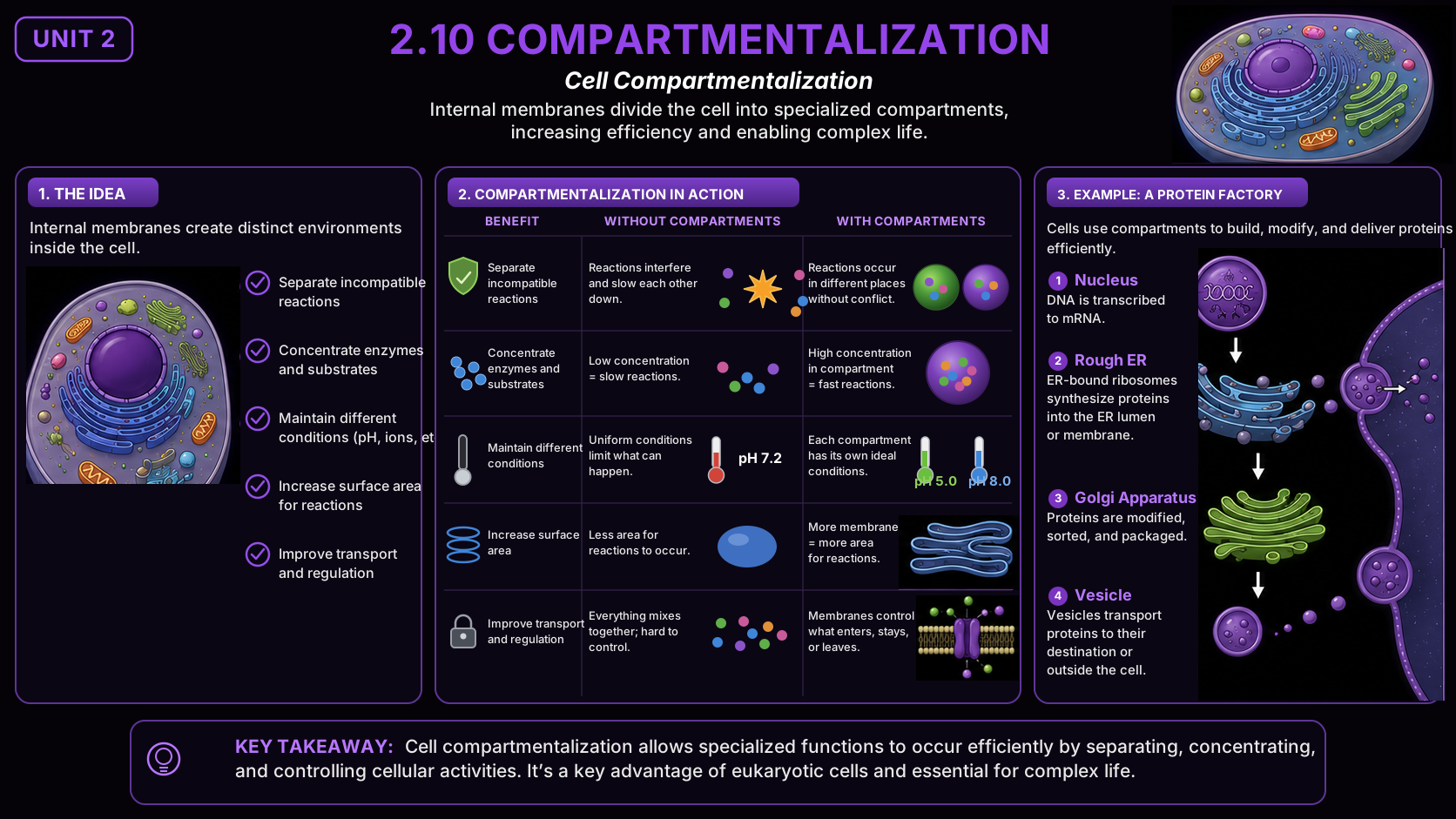
A cell is not one uniform pool of chemistry. Its interior is carved up by internal membranes into distinct compartments, and each compartment holds its own private mix of enzymes, ions, and pH. That partitioning is not incidental — it is what lets a single cell run reactions that would otherwise interfere. By walling off a space, the cell can concentrate the reactants of one process into a small volume, and separate reactions whose products would poison one another if they mixed. The lysosome keeps its digestive acid at pH 5 without acidifying the whole cytosol; the mitochondrion builds a proton gradient across an enclosed membrane that the open cytoplasm could never hold.
Read compartmentalization as a solution to a problem: chemistry that needs a specific environment gets its own room. A membrane-bound compartment raises local reactant concentration so a reaction runs fast enough to matter, and it isolates incompatible steps so that, say, synthesis and degradation don't undo each other in the same space. This is why eukaryotic cells can be large and metabolically busy — the internal membranes multiply the number of chemical environments a single cell can maintain at once. The compartment is not just a container; it is the reason the reaction inside it can happen at all.
Interactive · Compartmentalization
Build the cell's compartments and watch what partitioning buys you: concentrate reactants into a small volume to speed a reaction, and separate incompatible reactions so their products never meet.
Compartmentalization · Open the full sandbox →The common mistake here is treating a compartment as a mere container and missing why the wall matters. Students remember that the lysosome is acidic or that the mitochondrion makes ATP, but not that the enclosing membrane is what concentrates the reactants and separates the reactions in the first place. When that link is broken, compartmentalization becomes a label on a diagram rather than the mechanism that makes the chemistry work. Every scenario in this topic asks the same thing: say how the compartment concentrates or separates, not just which organelle it names.
The work
3 ways in · any order
Lesson
Cell Compartmentalization
›
Internal membranes divide the cell into compartments, and each one concentrates reactants or separates incompatible reactions. The lesson walks the ways students treat a compartment as a passive container and lose the mechanism, then closes with a ten-scenario applet: trace each process back to the compartment that makes it possible and say why the wall matters.
Diagnostic
10-item topic check
›
Ten items on compartmentalization (U2-BIO1, U2-BIO17): how an internal membrane concentrates reactants, how it separates reactions that would interfere, and catching the moments where a compartment gets treated as a passive container. Take it cold to surface which links are still broken, or after the lesson to confirm they hold.
Targeted Practice
Drill a single misconception
›
Pick one of the failure modes you missed and drill it on its own. The round is adaptive: two correct in a row clears the misconception and moves you to the next.