
Membrane Permeability
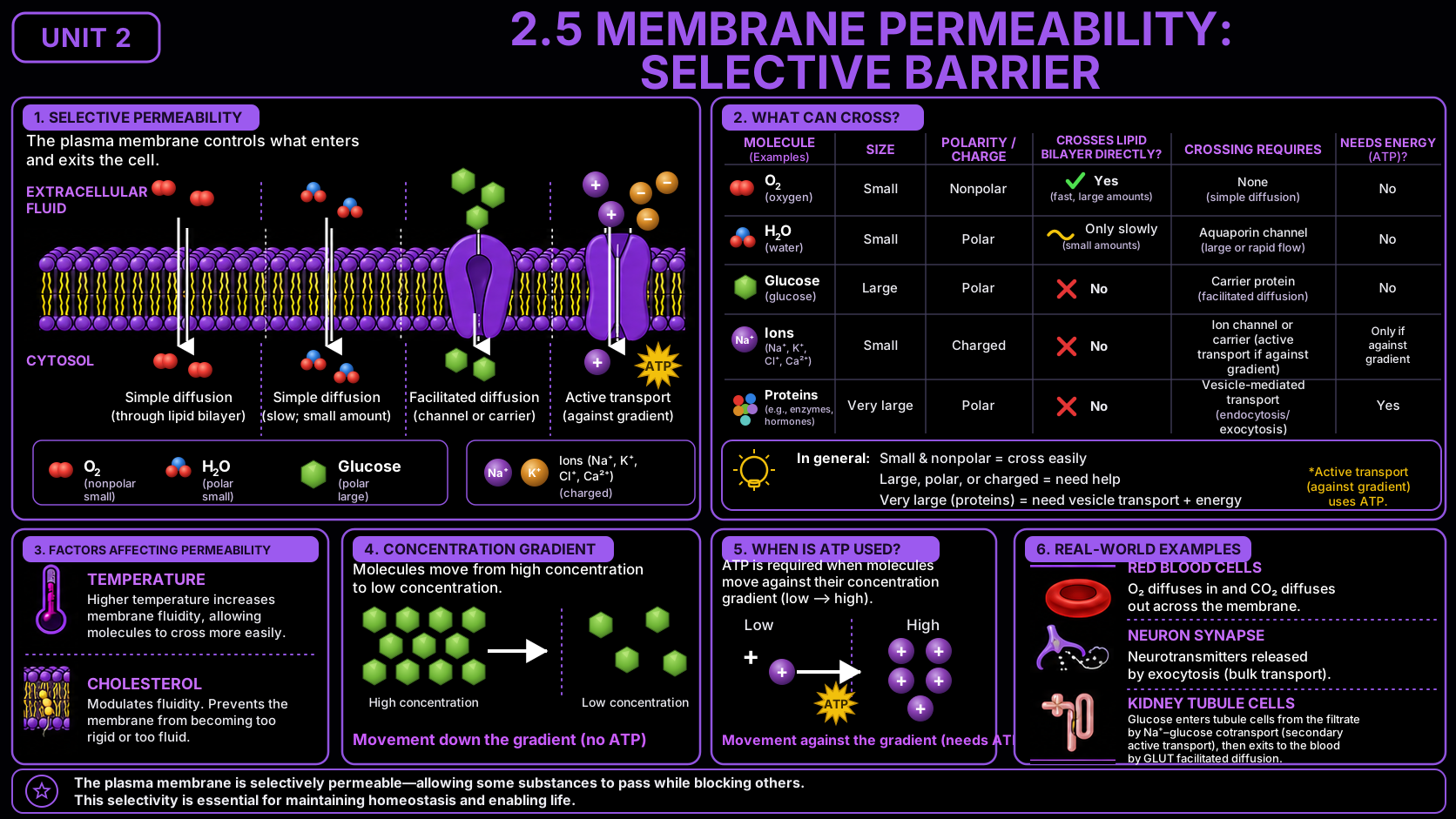
The cell membrane is not a wall and it is not an open door — it is a filter. Its phospholipid bilayer has a hydrophobic core, an oily interior that welcomes some molecules and blocks others. Small, nonpolar molecules like O2 and CO2 slip straight through; small uncharged polar molecules like water squeeze across slowly; but large polar molecules and every ion are stopped cold at that oily middle. The membrane's structure decides who crosses, and that decision is the whole point of a selectively permeable boundary.
What gets shut out is not abandoned — it is handed to a protein. Glucose, amino acids, and ions cannot dissolve through the hydrophobic core, so the membrane studs itself with channel and carrier proteins that open a hydrophilic path across. This is why permeability is a property of the whole membrane, not of the lipid alone: a molecule the bilayer refuses may still cross freely wherever the right transport protein sits. Read a molecule's size, charge, and polarity against the membrane's structure and you can predict its fate — free passage, protein-assisted passage, or no passage at all.
Interactive · Permeability Sorter
Sort each molecule by how it meets the membrane: free passage through the bilayer, protein-assisted passage through a channel or carrier, or no passage at all. Size, charge, and polarity on one side — the membrane's structure on the other.
Permeability Sorter · Open the full sandbox →The common mistake here is treating the membrane as one uniform gate: assuming that if a molecule is small it must cross, or that anything the bilayer blocks is blocked from the cell entirely. Both readings ignore that selective permeability comes from two structures working together — the lipid core that turns molecules away and the transport proteins that let the turned-away ones through. Every scenario in this topic asks the same thing: say why a molecule can or cannot cross, tracing its fate to the membrane feature it actually meets, not to size alone.
The work
3 ways in · any order
Lesson
Membrane Permeability
›
The membrane's structure decides which molecules cross and how. The lesson walks the ways students collapse permeability into a single size rule and lose the two-part logic of the bilayer and its transport proteins, then closes with a ten-scenario applet: read each molecule against the membrane and say why it passes freely, needs a protein, or is shut out.
Diagnostic
10-item topic check
›
Ten items on selective permeability, targeting three failure modes: assuming every molecule needs a transport protein, when small nonpolar ones cross the bilayer unaided (U2-BIO10), thinking the solute moves to even things out when the membrane blocks it and water is what actually crosses (U2-BIO14), and reading equilibrium as the moment motion stops rather than as balanced two-way traffic (U2-BIO2). Take it cold to surface which links are still broken, or after the lesson to confirm they hold.
Targeted Practice
Drill a single misconception
›
Pick one of the failure modes you missed and drill it on its own. The round is adaptive: two correct in a row clears the misconception and moves you to the next.