
Tonicity and Osmoregulation
Water moves. Across a selectively permeable membrane, it diffuses from where solute is dilute to where solute is concentrated — this is osmosis. The membrane holds back the solute, so the only way to even out the two sides is for water to travel toward the higher solute concentration. Nothing is pumping the water; it follows its own gradient, from higher water potential to lower. Read that sentence carefully: water goes toward the solute, not away from it, because the crowded side is the one where water is effectively scarcer.
Tonicity is how we describe a solution by the effect it has on a cell placed in it. A hypertonic solution has more solute outside than in, so water leaves the cell and it shrinks — an animal cell crenates, a plant cell plasmolyzes. A hypotonic solution has less solute outside, so water rushes in and the cell swells, and without a wall it can burst (lyse). An isotonic solution matches the cell's interior, so water crosses in both directions equally and there is no net change in volume. Tonicity is always a comparison — a solution is hypertonic relative to the cell, never on its own.
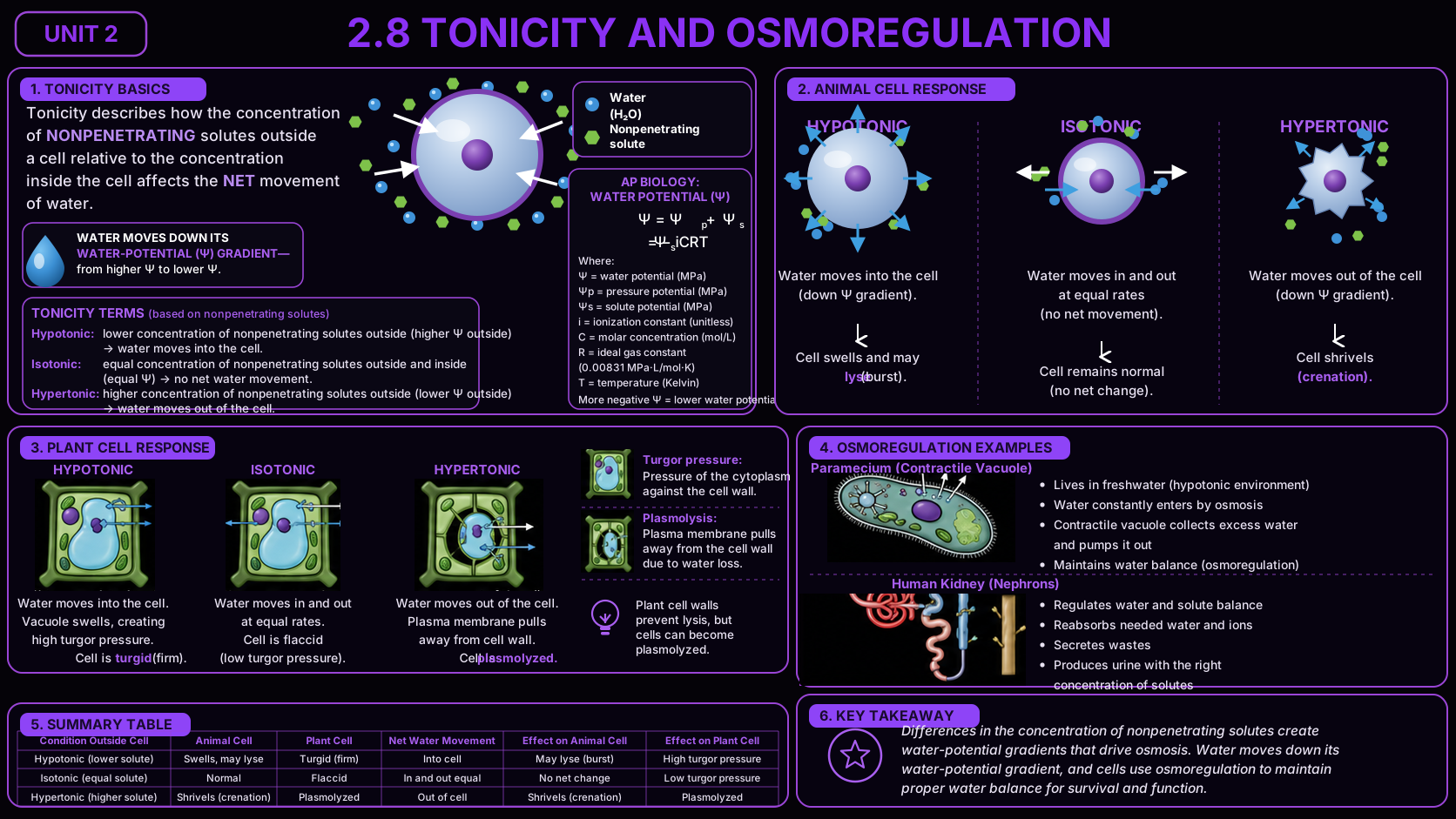
- Osmosis moves water toward higher solute. Across a selectively permeable membrane, water diffuses down its own gradient — from the dilute side to the concentrated side — because the solute cannot cross to meet it.
- Hypertonic → cell shrinks. More solute outside than in, so water leaves. Animal cells crenate; walled plant cells plasmolyze.
- Hypotonic → cell swells. Less solute outside than in, so water enters. Without a wall, the cell can lyse; with one, it becomes firm (turgid).
- Isotonic → no net change. Equal solute inside and out, so water crosses both ways at the same rate and volume holds steady.
- Osmoregulation is active control. Cells and organisms spend energy to hold water balance against these gradients — a Paramecium's contractile vacuole bails out incoming water; kidneys tune solute to defend blood volume.
The common mistakes cluster around the same confusion: treating the water as if it chased the solute out, or forgetting that tonicity is a relationship, not a property. Students say water flows “from high to low concentration” and mean solute, then send the water the wrong way. They call a solution hypertonic without asking relative to what, or predict that an isotonic solution stops all molecular motion rather than balancing two-way flow. Every scenario in this topic asks you to name the direction water actually goes and why the cell's volume changes — not just to label the beaker.
The work
3 ways in · any order
Lesson
Tonicity and Osmoregulation
›
Osmosis carries water toward the higher solute concentration, and tonicity names what that does to a cell's volume. The lesson walks the moments where students send water the wrong way or forget that hypertonic and hypotonic are comparisons, then closes with a ten-scenario applet: predict the direction of water flow, the change in volume, and how a cell osmoregulates to hold its balance.
Diagnostic
10-item topic check
›
Ten items on osmosis and tonicity: predicting the direction water crosses a membrane, reading a cell's volume change from a hypertonic, hypotonic, or isotonic surrounding, and how cells osmoregulate. The traps target the usual failure modes — reversing the flow (U2-BIO13), confusing solute and water gradients (U2-BIO14), treating tonicity as absolute rather than relative (U2-BIO15), and reading the isotonic case as motion stopping rather than as balanced two-way traffic (U2-BIO2). Take it cold to surface which are still shaky, or after the lesson to confirm they hold.
Targeted Practice
Drill a single misconception
›
Pick one of the failure modes you missed and drill it on its own. The round is adaptive: two correct in a row clears the misconception and moves you to the next.