 Mistake Master
Membrane permeability
The plasma membrane is not a wall — it is a selective filter. Some molecules slip straight through the oily core of the bilayer on their own; others cannot cross without a protein doorway. The rule is about the traveler: small and nonpolar passes freely, large or polar or charged does not. Get that one rule right and three of the most common exam traps — thinking everything needs a protein, thinking the solute moves in osmosis, and thinking equilibrium means motion stops — simply stop catching you.
§1
The one big idea: the membrane is selectively permeable.
▸
The whole topic rests on a single principle: the plasma membrane is selectively permeable. It lets some substances cross easily and blocks or slows others, and which is which is decided by the traveler, not the membrane. The oily interior of the phospholipid bilayer — the hydrophobic tails — is the gate that does the sorting.
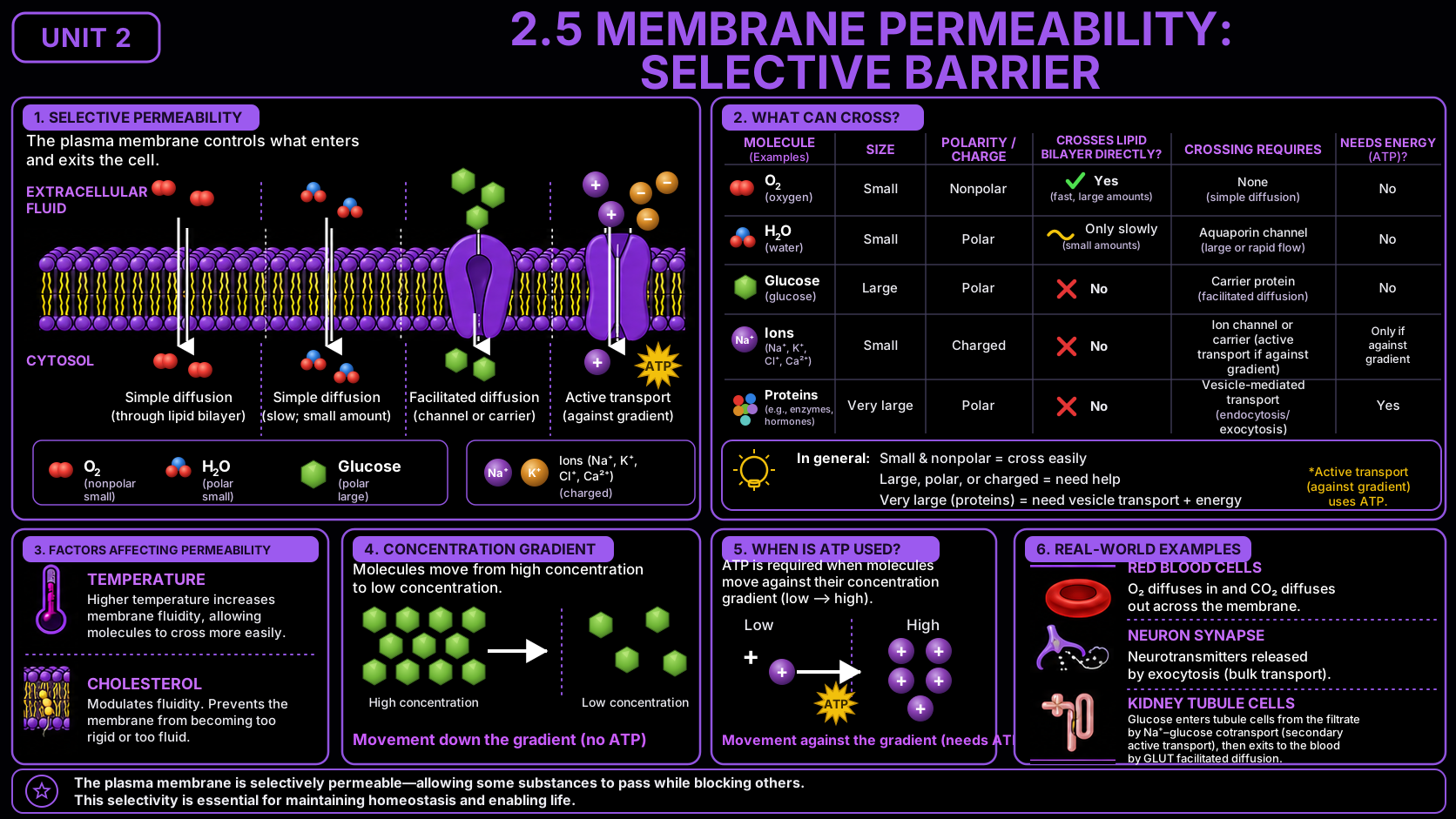
The rule comes down to two properties of whatever wants to cross: size and polarity. A molecule that is small and nonpolar dissolves right into the oily core and passes straight through the bilayer on its own, no help needed. A molecule that is large, or polar, or charged (an ion) is repelled by that oily core and cannot cross the bilayer directly — it needs a transport protein as a doorway.
Everything else in this lesson is that one rule applied to specific travelers: oxygen and carbon dioxide sailing through unaided, glucose and ions waiting for a protein, and water — the special case — moving by osmosis. Keep asking “is this traveler small and nonpolar, or not?” and the membrane becomes readable.
§2
Who crosses on their own, and who needs a doorway.
▸
Sort every traveler into one of two lanes: the ones that dissolve through the bilayer unaided, and the ones that must go through a protein. Read each entry as an application of the size-and-polarity rule.
- Small nonpolar molecules — straight through. Oxygen (O2) and carbon dioxide (CO2) are tiny and nonpolar, so they dissolve into the oily core and cross the bilayer directly, no protein required. This is why a cell can take in O2 and dump CO2 without spending anything on transport machinery.
- Small uncharged molecules — also unaided, more slowly. Small molecules with no net charge, such as water and (to a lesser degree) other tiny neutral molecules, can slip across the bilayer on their own, though more slowly than the nonpolar ones. The point stands: not every crossing needs a protein.
- Large or polar molecules — protein required. Glucose and amino acids are big and polar. The oily core repels them, so they cannot cross the bilayer directly — they move through channel or carrier proteins that provide a hydrophilic path.
- Ions — always a protein. Charged particles like Na+, K+, and Cl− are strongly repelled by the hydrophobic interior. Even though many ions are small, their charge keeps them out of the bilayer, so they cross only through protein channels.
- Water — the special case. Water is small and uncharged, so some slips directly across; but because cells move so much of it, most water crosses through dedicated channel proteins called aquaporins. The movement of water across the membrane has its own name — osmosis — and its own rules, covered next.
Notice the single question running through all five: is the traveler small and nonpolar? If yes, it crosses the bilayer on its own. If it is large, polar, or charged, it needs a protein. Naming that property tells you the lane.
§3
The travelers you'll meet.
▸
Quick reference card. For each traveler, read whether it crosses the bilayer directly or needs a protein, and why — that pairing is the whole game.
§4
Osmosis and dynamic equilibrium.
▸
Two ideas trip up more students on this topic than anything else: what actually moves in osmosis, and what “equilibrium” really means. Both follow from diffusion — the tendency of particles to spread from where they are crowded to where they are sparse.
Diffusion. Molecules in constant random motion spread out from high concentration toward low concentration. It is passive: no energy is spent, the motion is just the built-in jiggling of the particles. For a substance that can cross the membrane, diffusion carries it down its own concentration gradient until the gradient is gone.
Osmosis is diffusion of water. Here is the key move. When a solute (say, salt or sugar) is trapped on one side of the membrane because it can't cross, the imbalance is settled by moving the thing that can cross: water. Water diffuses across the membrane toward the side with more solute (lower water concentration). So in osmosis it is the water that moves, not the solute. If you ever catch yourself picturing the salt sliding across to even things out, stop — the salt is stuck, which is exactly why the water has to move instead.
Which way does water go? Water moves toward the region of higher solute concentration, because that is the region where water itself is comparatively scarce. Add solute to a side and you pull water in. This is the whole logic behind why cells swell in dilute surroundings and shrink in salty ones.
Dynamic equilibrium. Diffusion ends at equilibrium — but equilibrium does not mean the molecules stop. They keep moving, colliding, and crossing the membrane in both directions just as fast as before. What becomes zero is the net flow: for every molecule going one way, one goes back the other way. The concentrations stop changing; the motion never does. That is why it's called dynamic equilibrium — balanced two-way traffic, not a parking lot.
Putting it together. Small nonpolar molecules like O2 diffuse down their gradient straight through the bilayer until net flux hits zero. Water diffuses (osmosis) toward higher solute concentration. And at equilibrium, everything is still in motion — the traffic has just balanced out. Keep those three straight and Topic 2.5 is yours.
§5
3 mistakes that cost real points.
▸
“Everything needs a transport protein to cross the membrane.”
Students learn about channels and carriers and over-apply them, deciding that nothing gets across without a protein. But small nonpolar molecules — O2, CO2 — and small uncharged ones dissolve right into the oily core and cross the bilayer directly, no protein involved. Proteins are for the travelers the bilayer rejects: the large, the polar, and the charged. If you say “everything needs a protein,” you'll get simple gas-exchange questions wrong.
Fix. Ask first: is this molecule small and nonpolar? If yes, it crosses on its own. Only reach for a transport protein once you've decided the traveler is large, polar, or charged.
“In osmosis, the solute moves across to even out the concentrations.”
This gets osmosis exactly backwards. The reason osmosis happens at all is that the solute can't cross the membrane — it's stuck on its side. The imbalance gets settled by moving the thing that can cross: water. Water diffuses toward the side with more solute. So it is the water that moves, never the trapped solute. Picture the salt sliding across and you've invented a crossing that isn't allowed.
Fix. Whenever a problem says a solute can't cross, immediately flip your attention to the water: it moves toward higher solute concentration. Osmosis is water diffusion, full stop.
“Once diffusion reaches equilibrium, the molecules stop moving.”
Equilibrium is the endpoint of diffusion, and students imagine it as everything coming to rest. It isn't. At equilibrium the molecules are still in constant motion and still crossing the membrane in both directions — just as many going each way. What hits zero is the net flow, so the concentrations stop changing. The motion never stops; that's why it's called dynamic equilibrium.
Fix. Read “equilibrium” as balanced two-way traffic, not stopped traffic. Net movement is zero; individual molecules keep moving and keep crossing.
§6
Skill Check.
▸
Ten scenarios. Pick the chips that match your answer, then check. A scenario marks complete the first time every part is right. Progress saves on this device.