 Mistake Master
Cell compartmentalization
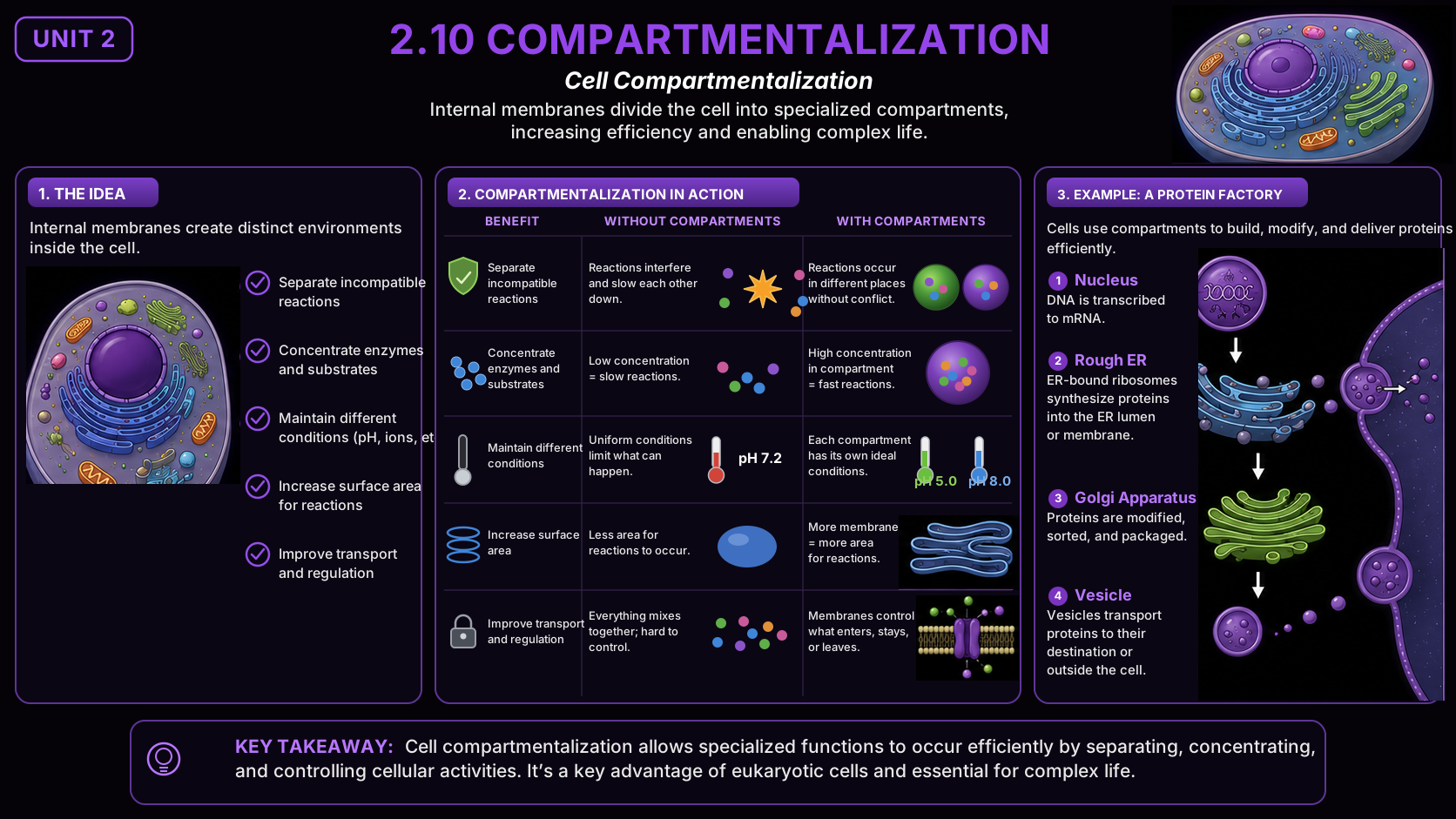
Internal membranes carve a eukaryotic cell into compartments — and those walls are the whole point. A membrane lets one pocket run acidic while the cytoplasm stays neutral, keeps a digestive enzyme from touching what it must not, concentrates the right reactants in one small volume, and packs enormous reactive surface into a tiny cell. Compartments matter. Learn to read why a reaction needs its own room, and each organelle's structure stops being a list to memorize and becomes a consequence of the job it does.
§1
The one big idea: structure fits function.
▸
The whole topic rests on a single principle: internal membranes divide a eukaryotic cell into separate compartments, and those compartments matter. A membrane is not just a bag — it is a wall that lets the chemistry inside differ from the chemistry outside. Take the walls away and the same molecules are still present, but the cell can no longer run reactions that need to be kept apart, kept concentrated, or kept at their own special conditions.
Why does compartmentalizing help? Four reasons, and every organelle is an example of at least one. A compartment can concentrate reactants in a small volume so a reaction actually proceeds; it can separate incompatible reactions so one process doesn't undo or destroy another; the folded internal membranes add reactive surface area far beyond what the outer membrane alone could offer; and a sealed space lets the cell hold its own local conditions — a pH, an ion concentration, a voltage — that would be impossible if everything mixed freely.
This is why a lysosome can run at acidic pH while the cytoplasm stays near neutral, why a mitochondrion can build a proton gradient across its inner membrane, and why the reactions that make and break down molecules can happen in the same cell without colliding. And notice the corollary: because each compartment's job sets what it must contain, an organelle's structure fits its function. Keep asking “why does this reaction need its own room?” and the whole cell becomes readable.
§2
Four jobs a compartment does.
▸
Compartmentalizing isn't decoration — it buys the cell four concrete advantages. Every membrane-bound organelle earns its keep through at least one of them.
- Concentrate reactants. Squeeze the enzymes and substrates for one process into a small volume and they collide far more often, so the reaction actually runs at a useful rate. A dilute cytoplasm can't do that; a compartment can. This is why so much chemistry is packed into tiny organelles instead of spread across the whole cell.
- Separate incompatible reactions. Some processes would sabotage each other if they mixed — a pathway that builds a molecule and one that tears it down, or a digestive enzyme and the cell's own proteins. A membrane wall keeps them apart, so both can run at once in the same cell without collision.
- Add membrane surface area. Many reactions happen on membranes. Folding membranes into the interior — cristae, thylakoids, ER sheets — packs an enormous reactive surface into a small cell, far more than the outer plasma membrane alone could provide.
- Hold local conditions. A sealed compartment can maintain a pH, an ion concentration, or a voltage different from its surroundings. The lysosome sits at acidic pH; the mitochondrion stores energy as a proton gradient across its inner membrane. Neither is possible if the contents mix freely with the cytoplasm.
Notice the pattern across all four: the value comes from the wall, from keeping inside different than outside. Whenever a question asks why a process happens in its own organelle, the answer is one of these four — compartments matter.
§3
Compartments and what their walls buy.
▸
Quick reference card. For each compartment, read what its membrane makes possible — the local condition it holds or the reaction it isolates. That is why the compartment exists.
§4
Why each compartment needs its own room.
▸
Walk through the classic organelles, but this time ask the compartment question: what does the wall make possible that an open cytoplasm could not?
Lysosome — a private acid bath. Its digestive enzymes work best near pH 5, well below the neutral cytoplasm. The membrane does two jobs at once: it holds that acidic condition inside, and it isolates a destructive reaction so the enzymes break down waste instead of the cell's own parts. Loose in the cytoplasm the enzymes would be both mis-tuned (wrong pH) and dangerous. The compartment is the whole point.
Mitochondrion — a battery you can only build behind a wall. The inner membrane folds into cristae, adding surface area, and it pumps protons into the space between its membranes. That builds a proton gradient — more H+ on one side than the other — whose stored energy drives ATP synthesis. A gradient is a difference across a barrier; with no sealed compartment, the protons simply mix away and there is nothing to store. Local conditions plus surface area, working together.
Chloroplast — the same trick with light. Stacked thylakoid membranes give a huge light-catching surface, and the sealed thylakoid space lets the organelle pump protons and build a gradient just as the mitochondrion does. Two of the four advantages — surface area and a held-apart local condition — in one organelle.
Nucleus — keeping two steps apart. The pored envelope separates transcription (making RNA from DNA, inside) from translation (building protein from RNA, outside). That separation lets the cell process and edit RNA before it is ever used, and concentrates the machinery for handling the genome in one controlled space. Isolation of incompatible steps, again enabled by a wall.
ER and vesicles — concentrate and route. The enclosed ER lumen gives newly made proteins a concentrated, controlled space to fold and be modified, kept separate from the cytosol. Vesicles then carry finished product to its destination without ever spilling it into the general interior — concentration and separation in service of clean delivery.
Vacuole — a storage compartment. A membrane-bound space concentrates water, ions, and waste apart from the cytoplasm. In plant cells the filled central vacuole even holds pressure against the wall — a local condition (turgor) that only a sealed compartment can maintain.
The through-line. Every one of these earns its keep by keeping inside different from outside: an acid bath, a proton gradient, a separated reaction, a concentrated lumen. Change or remove the compartment and the function collapses — compartments matter, and each organelle's structure is fitted to the job its wall makes possible. That is the heart of Topic 2.10.
§5
3 mistakes that cost real points.
▸
“Compartments don't really matter — the same molecules are in the cell either way, so why wall them off?”
This is the core misconception of the topic. Students figure that if a cell contains the right enzymes and substrates, the reaction will happen wherever they are — membranes are just tidy packaging. But the wall is the function. Dumped into the open cytoplasm, a lysosome's enzymes sit at the wrong pH and endanger the cell; a mitochondrion's protons mix away and store no energy; two incompatible pathways collide. Remove the compartment and the process fails, even though every molecule is still present.
Fix. For any organelle, ask “what would break if I tore the membrane down?” If the answer is a lost pH, a collapsed gradient, or a reaction now free to attack the cell, you've found why the compartment matters.
“A membrane's only role is to be a bag that holds stuff in one place.”
Another face of the “compartments don't matter” error. Holding contents together is the least of it. The membrane's real payoff is that it lets inside differ from outside: it maintains a local pH or ion concentration, it stores energy as a gradient across itself, and it isolates a reaction so it can run without wrecking its neighbors. A bag keeps things nearby; a compartment keeps conditions different.
Fix. When you name an organelle, name the difference its wall maintains — acidic vs. neutral, high-H+ vs. low-H+, building vs. breaking down. If there's no difference across the membrane, you haven't explained why the compartment exists.
“An organelle's structure is just a shape — its job is a separate fact to memorize.”
The structure–function disconnect. Students treat “the inner membrane is folded into cristae” and “the mitochondrion stores a proton gradient” as two unrelated facts, then can't handle a question that rewords either. But the folded, sealed inner membrane is the reason a gradient can exist — the surface holds the pumps and the wall holds the difference. Structure and function are one idea, matched because the compartment's job sets what it must contain.
Fix. For every organelle, finish the sentence “this structure enables this job because…” If you can't, you've memorized two labels instead of understanding one compartment.
§6
Skill Check.
▸
Ten scenarios. Pick the chips that match your answer, then check. A scenario marks complete the first time every part is right. Progress saves on this device.