 Mistake Master
Mechanisms of transport
Transport proteins are terrific for moving one small solute at a time — a single ion, a single glucose molecule. But what if a cell needs to swallow a whole bacterium, or dump a flood of hormone all at once? No protein has a channel wide enough. For anything large, or in bulk, the cell uses the membrane itself: it wraps cargo in a vesicle and either takes it in (endocytosis) or ships it out (exocytosis). No carrier, no channel — just membrane folding around material, at the cost of ATP.
§1
The one big idea: for big cargo, the membrane does the work — not a protein.
▸
Everything you learned about membrane transport so far moves small things: an ion slips through a channel, a glucose molecule rides a carrier, water diffuses across. Each of those uses a transport protein, and each moves essentially one particle at a time. That is fine for solutes — but it cannot move a virus, a cell fragment, a droplet of fluid, or a whole batch of hormone. Those are far too big to fit through any protein.
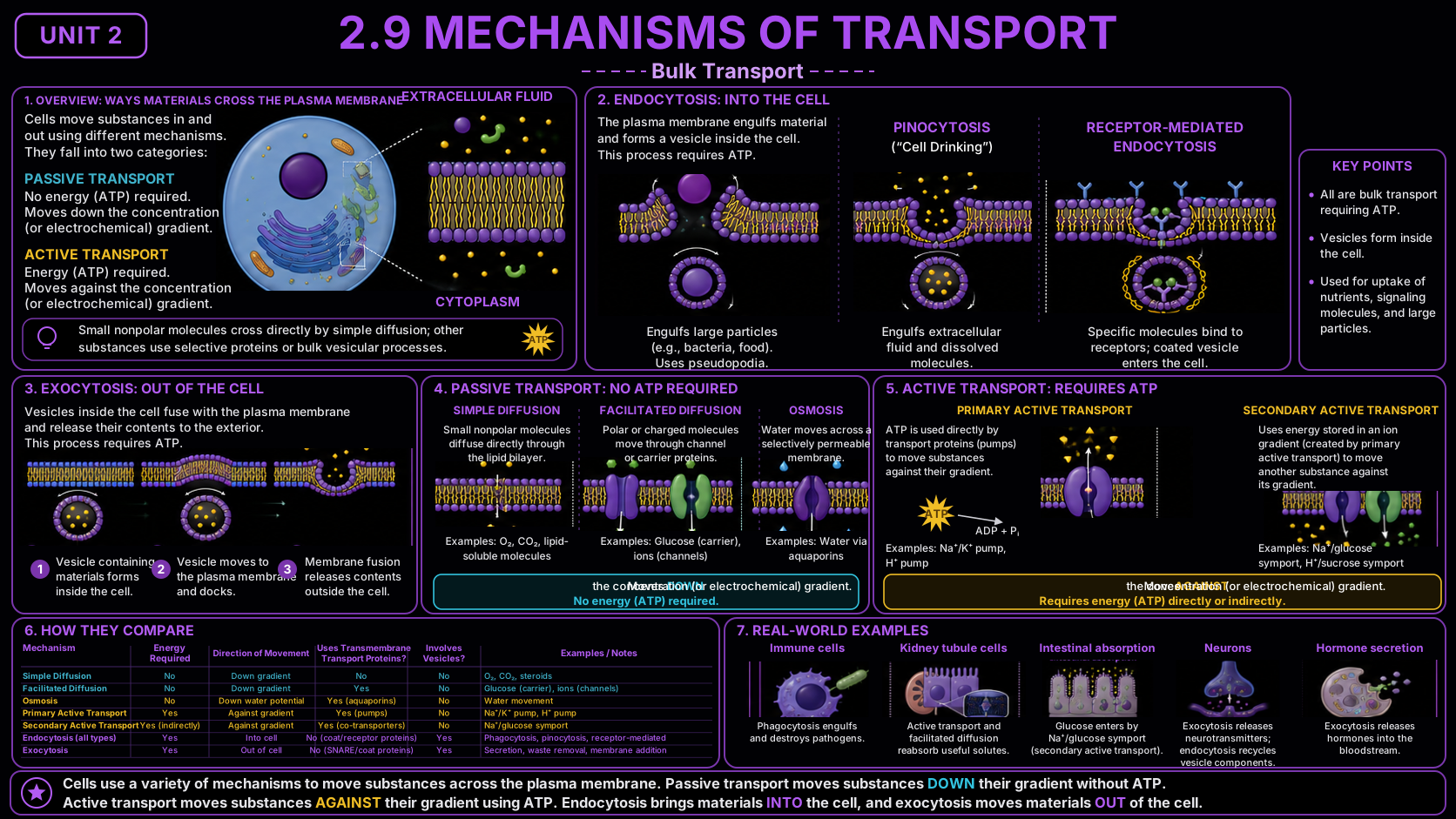
So for large particles and large quantities, the cell abandons proteins entirely and uses the membrane itself. It pinches a piece of membrane around the cargo to make a vesicle — a little membrane-wrapped bubble. To bring material in, the membrane folds inward and buds off a vesicle: that is endocytosis. To send material out, a vesicle travels to the membrane and fuses with it, spilling its contents outside: that is exocytosis. This whole family of moves is called bulk transport.
Two features set bulk transport apart from protein-based transport. First, no channel or carrier is involved at all — the membrane physically bends, wraps, and re-seals. Second, that remodeling takes energy: bulk transport always costs ATP. Keep asking “is this cargo small enough for a protein, or big enough to need a vesicle?” and you will always pick the right mechanism.
§2
Endocytosis: folding the membrane inward to bring material in.
▸
In endocytosis (“endo” = into) the plasma membrane caves inward around external material, then pinches off a vesicle that carries the cargo into the cytoplasm. There are three flavors, sorted by what is being taken in.
- Phagocytosis — “cell eating.” The cell engulfs a large solid particle — a bacterium, a piece of debris, a dead cell — by extending membrane around it and sealing it into a big vesicle. This is how a white blood cell swallows a pathogen. Far too big for any channel; only wrapping membrane will do.
- Pinocytosis — “cell drinking.” The membrane dimples in and gulps a droplet of extracellular fluid along with whatever solutes happen to be dissolved in it. It is non-specific and continuous — the cell samples its surroundings in bulk rather than picking out one molecule.
- Receptor-mediated endocytosis — the targeted pickup. Receptor proteins on the membrane bind a specific molecule (a ligand). Once enough are bound, that patch of membrane folds in and buds off a vesicle rich in the target. Note the role of the receptors: they only recognize and grab the cargo — the actual crossing is still done by the membrane pinching inward, not by the protein ferrying anything through itself.
Across all three, the pattern is identical: membrane wraps cargo, vesicle buds inward, ATP is spent. Even receptor-mediated endocytosis — the one that involves proteins — uses those proteins only to select cargo, never as a tunnel.
§3
The mechanisms you'll meet.
▸
Quick reference card. Every one of these moves cargo with a vesicle and the membrane — not a channel or carrier — and every one spends ATP.
§4
Exocytosis, the energy bill, and how bulk transport differs from protein transport.
▸
Endocytosis brings material in; exocytosis does the reverse, and both round out the machinery of bulk transport.
Exocytosis — shipping material out. A vesicle produced inside the cell (often packaged by the Golgi) travels to the plasma membrane and fuses with it. As the two membranes merge, the vesicle turns inside-out onto the cell surface and dumps its contents into the extracellular space. This is how cells secrete: a gland cell releases a hormone, a digestive cell releases an enzyme, a neuron releases neurotransmitter. Again, no channel or carrier is threaded — the vesicle membrane simply becomes part of the plasma membrane.
Bulk transport always costs ATP. Bending the membrane, wrapping cargo, pinching off a vesicle, transporting it, and fusing it back all require the cell to spend energy. Unlike passive diffusion or facilitated diffusion — which ride the gradient for free — endocytosis and exocytosis are active processes: no ATP, no bulk transport. Do not confuse this with active transport through a pump, though; here the energy pays for membrane remodeling, not for a protein carrier working against a gradient.
Membrane remodeling and balance. Every endocytosis event removes a piece of plasma membrane (it leaves as a vesicle); every exocytosis event adds a piece back (the vesicle fuses in). A busy cell keeps these roughly balanced so its surface area stays stable — the membrane is constantly being recycled between the surface and internal vesicles.
The key contrast — single solute vs. bulk. This is the whole point of the topic. A transport protein (channel or carrier) moves one small solute at a time through the protein itself — an ion, a sugar, an amino acid. Bulk transport moves large particles or large quantities by wrapping them in vesicles made of membrane. When cargo is small enough to fit a protein, the cell uses a protein; when cargo is a bacterium, a fluid droplet, or a whole batch of secreted product, only a vesicle will do. Ask “small solute, or big/bulk cargo?” and the mechanism picks itself.
§5
3 mistakes that cost real points.
▸
“Bulk transport uses a big transport protein — a wide channel or carrier — to pull the material across.”
This is the signature misconception of the topic (bulk transport is protein-mediated). Students carry over the channel/carrier picture from facilitated diffusion and imagine a huge protein pore swallowing a bacterium or piping out a hormone. But no protein is anywhere near wide enough, and that is not how it works: the membrane itself folds around the cargo and buds off (or fuses in) a vesicle. The mover is a piece of membrane, not a protein tunnel.
Fix. When cargo is large or in bulk, picture the membrane wrapping it in a vesicle, not a protein channeling it through. Proteins move single small solutes; vesicles move everything big.
“Receptor-mediated endocytosis is protein transport, since it uses receptor proteins.”
The receptors are real, but look at what they do: they only recognize and grab the specific ligand. Nothing passes through the receptor. Once cargo is bound, that patch of membrane still folds inward and pinches off as a vesicle — the crossing is done by membrane remodeling, exactly like the other forms of endocytosis. A protein selecting cargo is not the same as a protein transporting cargo.
Fix. Separate two jobs: selecting cargo (receptors can do that) versus ferrying it across (only the membrane does that, by making a vesicle). Receptor-mediated endocytosis is still vesicle transport.
“Endocytosis and exocytosis are passive, so they're free like diffusion.”
They are not free. Folding the membrane, wrapping cargo, and fusing vesicles all take work, so bulk transport always costs ATP — it is an active process. It is easy to lump it in with passive diffusion because no obvious pump is visible, but the energy is being spent on membrane remodeling rather than on a carrier fighting a gradient.
Fix. Tie the two facts together: bulk transport = vesicles = membrane bending = ATP. If a process makes or fuses a vesicle, it is active, full stop.
§6
Skill Check.
▸
Ten scenarios. Pick the chips that match your answer, then check. A scenario marks complete the first time every part is right. Progress saves on this device.