 Mistake Master
Membrane transport
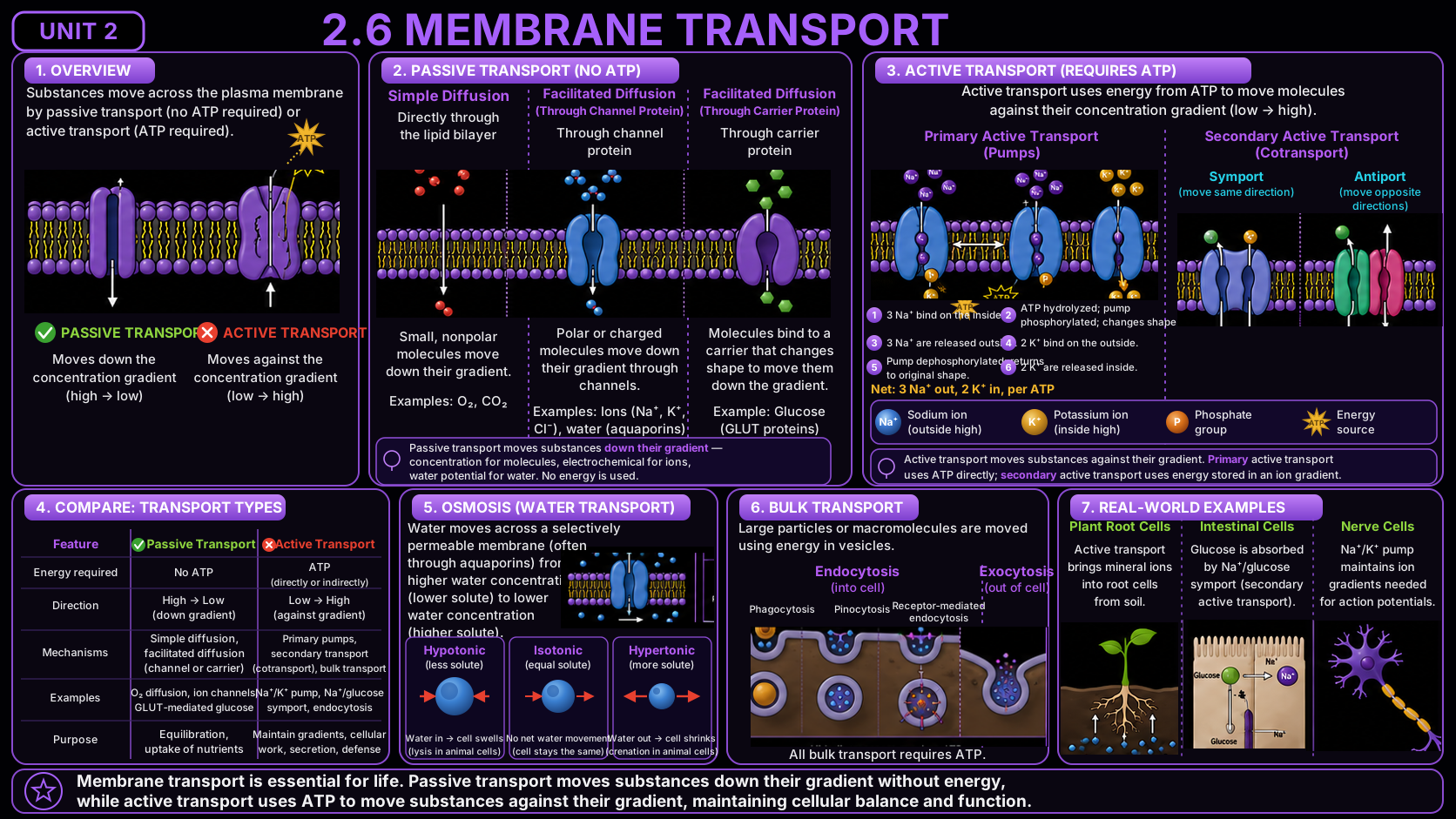
Every substance a cell takes in or pushes out crosses the membrane one of two ways. Passive transport lets things drift down their concentration gradient — from crowded to empty — and it costs the cell nothing. Active transport shoves things the other way, against the gradient, and that uphill work has to be paid for with ATP. The whole topic is learning which is which: whether a move needs energy, whether it needs a protein, and what "equilibrium" really means once the traffic settles.
§1
The one question: which way, and who pays?
▸
Every transport question comes down to two things: which direction a substance is moving relative to its concentration gradient, and who pays the energy bill. Get those two straight and the whole topic falls into place.
A concentration gradient is just a difference in how crowded a substance is on the two sides of the membrane. Moving down the gradient — from where it's crowded to where it's sparse — is the direction things drift on their own, like a crowd spilling out of a packed room into an empty hallway. That's passive transport, and it needs no ATP because the gradient itself does the pushing. Moving up the gradient — making something more crowded where it's already crowded — is uphill work that never happens for free. That's active transport, and it requires ATP.
So the reasoning is always the same two steps. First ask: is the substance going down its gradient (passive, free) or up against it (active, costs ATP)? Then, and only then, worry about the details — whether a protein is involved, whether it's water or a solute doing the moving. Direction and energy first; everything else is secondary.
§2
Passive transport: three ways to drift downhill for free.
▸
Passive transport is any move that goes down the gradient, so the cell spends no ATP. It comes in three flavors — and it is worth stressing up front that all three are passive, no matter how fancy the last one sounds.
- Simple diffusion — small nonpolar molecules cross directly. Substances like O2 and CO2 are small and nonpolar, so they slip straight through the lipid bilayer with no help at all, moving from where they're concentrated to where they're not. No protein, no ATP — the gradient does the work.
- Osmosis — the diffusion of water. Osmosis is just diffusion applied to water. Water moves across the membrane from where water is more concentrated (dilute solution) toward where it is less concentrated (concentrated solution) — that is, toward the higher solute concentration. Still passive, still no ATP; it's the water that moves, not the solute.
- Facilitated diffusion — passive, but through a protein. Large or charged particles (glucose, ions) can't cross the oily bilayer on their own, so they pass through channel or carrier proteins. Here's the key: the protein is just an open door down the gradient. Facilitated diffusion is still passive — the substance moves from high to low concentration, and no ATP is spent. The protein provides a path; it does not provide a push.
Notice the pattern across all three: the substance always moves down its gradient, and the cell never pays. A protein may or may not be involved — but the presence of a protein does not make transport active. Direction is what makes it passive.
§3
The transport modes at a glance.
▸
Quick reference card. For each mode, read the direction, the energy cost, and whether a protein is required — those three facts settle almost every question.
§4
Active transport, and what "equilibrium" really means.
▸
Passive transport handles everything moving downhill. Active transport handles the opposite — the moves a cell needs but the gradient won't give it for free.
Active transport — paying to go uphill. Sometimes a cell needs to concentrate a substance against its gradient: pull something in even though there's already more of it inside, or push something out even though it's scarcer outside. The gradient fights this every step, so the cell must spend energy — ATP — to power a pump protein that forces the substance the wrong way. Direction is the giveaway: if a substance is moving from low concentration to high, it is active transport, and ATP is being burned.
The sodium-potassium pump — the classic example. The Na+/K+ pump moves sodium out of the cell and potassium in, both against their gradients, using ATP each cycle. This is the go-to illustration of active transport: a protein that doesn't just open a door but actively shoves ions uphill, at a cost.
Not everything needs a protein. It's tempting to think every substance requires a special protein to get across, but that's false. Small nonpolar molecules like oxygen and carbon dioxide dissolve right through the lipid bilayer on their own. Proteins are needed only for particles that can't cross the oily interior — the large ones and the charged ones. A protein is a tool for specific cargo, not a universal requirement.
Equilibrium is dynamic, not frozen. When a substance finishes diffusing and its concentration is equal on both sides, students often picture the molecules stopping. They don't. At equilibrium molecules keep crossing the membrane in both directions — they just cross at equal rates, so there is no net change. Motion never stops; the two flows simply balance. That constant two-way traffic is what "dynamic equilibrium" means.
Putting it together. Ask the two questions in order. Which direction relative to the gradient? Down means passive and free; up means active and ATP-powered. Then: does this particular substance need a protein to cross? Small and nonpolar, no; large or charged, yes — but needing a protein still doesn't decide whether it's passive or active. Direction decides that.
§5
4 mistakes that cost real points.
▸
“Passive transport needs energy, and facilitated diffusion uses ATP because it involves a protein.”
This is the signature error of the topic. Passive transport by definition spends no ATP — the gradient supplies the push. Students get tripped up by facilitated diffusion: because it uses a channel or carrier protein, they assume the protein must cost energy. It doesn't. The protein is only an open door down the gradient; the substance still moves from high to low concentration on its own. Facilitated diffusion is passive.
Fix. A protein is not a battery. Ask which way the substance moves: down the gradient means passive and free, protein or no protein. Only movement against the gradient costs ATP.
“Active transport moves substances down the gradient, from high to low.”
The direction gets flipped. Active transport exists precisely to move substances against the gradient — from low concentration to high — which is why it needs ATP. Moving down the gradient is what happens for free, so it can't be the thing you'd spend energy on. If a substance is going from where it's crowded to where it's sparse, that's passive; active transport is the uphill case.
Fix. Tie direction to cost. Uphill (low → high) = active = ATP. Downhill (high → low) = passive = free. If someone tells you a pump burns ATP to move something downhill, the story is broken.
“Every substance needs a transport protein to cross the membrane.”
Not true. Small nonpolar molecules — oxygen, carbon dioxide — dissolve straight through the lipid bilayer with no protein at all. Proteins are needed only for the particles that can't cross the oily interior: the large ones and the charged ones. Assuming a protein is always required makes you misread simple diffusion as something more complicated.
Fix. Check the molecule first. Small and nonpolar? Straight through the bilayer, no protein. Large or charged? Then it needs a channel or carrier. The cargo decides, not a blanket rule.
“Once a substance reaches equilibrium, the molecules stop moving.”
Equilibrium is not stillness. When concentrations even out, molecules keep crossing the membrane in both directions — they just cross at equal rates, so there is no net movement. The traffic never halts; the two opposing flows simply balance. That's why it's called dynamic equilibrium.
Fix. Separate “net change” from “motion.” At equilibrium the net change is zero, but the molecules are still shuttling both ways as fast as ever.
§6
Skill Check.
▸
Ten scenarios. Pick the chips that match your answer, then check. A scenario marks complete the first time every part is right. Progress saves on this device.