 Mistake Master
Why cells stay small
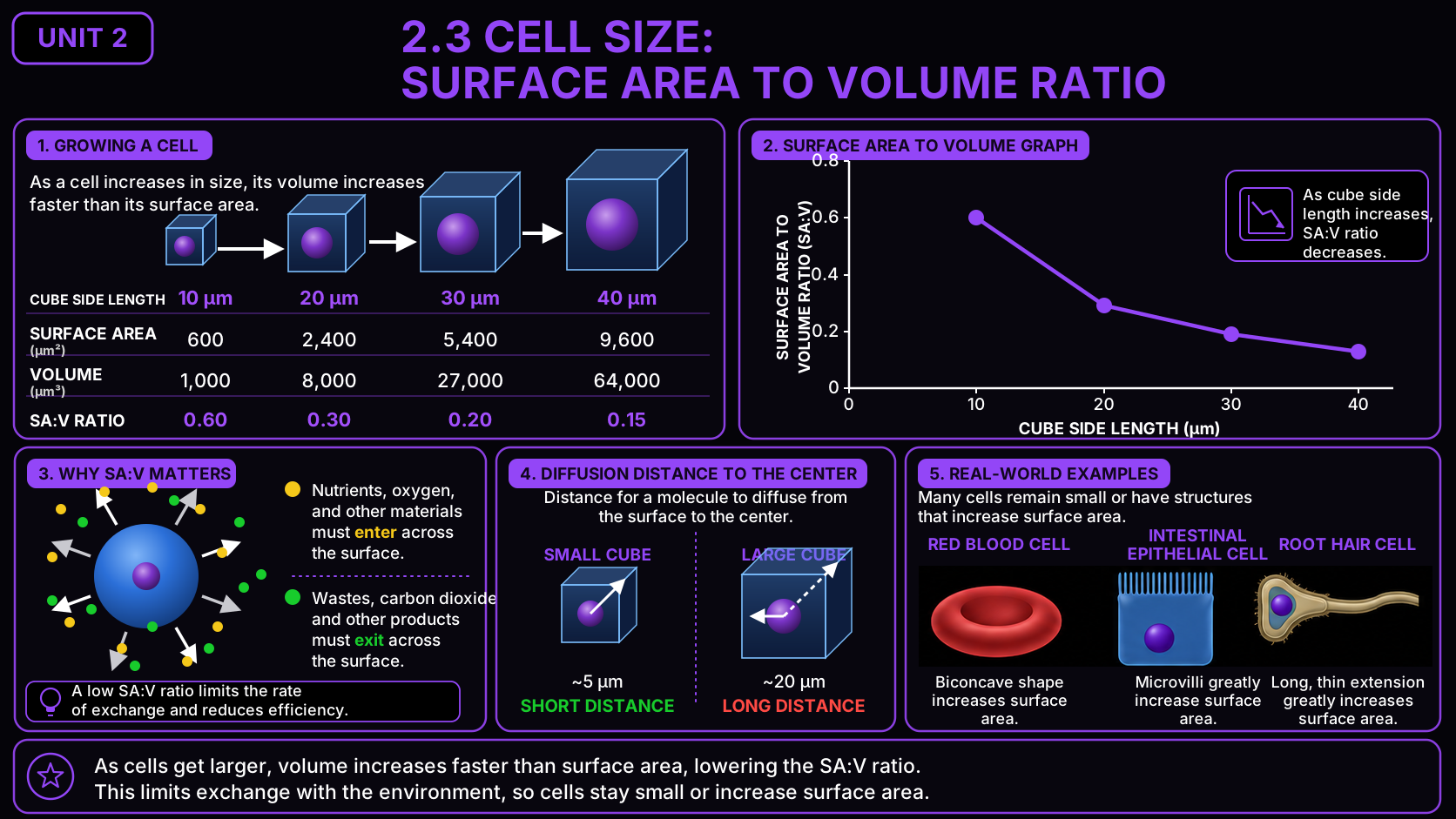
Grow a cell and its volume races ahead of its surface. Everything a cell needs — food in, waste out, signals across — has to pass through its membrane, but the demand for that traffic scales with the volume inside. Double a cell's width and the volume grows eightfold while the surface only quadruples, so the surface-area-to-volume ratio falls. That single geometric fact is why big cells choke on their own logistics, and why cells stay small, flatten, fold their membranes, or simply divide.
§1
The one big idea: volume outgrows surface.
▸
The whole topic rests on a single geometric fact: as a cell gets bigger, its volume grows faster than its surface area. Volume goes up with the cube of the cell's size while surface area goes up only with the square. So every time a cell grows, the amount of membrane it has per unit of interior shrinks — the surface-area-to-volume ratio (SA:V) falls.
Why that matters: the surface is where all exchange happens. Nutrients and oxygen come in across the membrane, wastes go out across it, and the whole interior volume is what generates that demand. A cell with lots of surface per volume can service its insides easily. As volume outpaces surface, that gets harder — the demand from the interior keeps climbing while the membrane serving it doesn't keep pace, and the deep interior is the first to feel it.
So the SA:V ratio is a measure of efficiency of exchange: high ratio, efficient; low ratio, inefficient. Read it that way and the rest of the topic falls out. Small cells win. Growing cells lose ground. And the shapes cells adopt — flat, folded, branched — are all tricks to keep the ratio high despite getting bigger. Keep asking “how much surface does this cell have for its volume?” and the whole picture becomes readable.
§2
The numbers: watch a cube grow.
▸
You don't need heavy math — a cube makes the whole idea concrete. For a cube of side s, surface area is 6s2 (six faces) and volume is s3. Divide them and the SA:V ratio is simply 6/s. The bigger the side, the smaller the ratio — SA:V is literally inversely proportional to size. Walk it up step by step:
- Side = 1. Surface = 6×12 = 6. Volume = 13 = 1. SA:V = 6/1 = 6. Lots of surface per unit of interior — exchange is easy.
- Side = 2 (doubled). Surface = 6×22 = 24 (up 4×). Volume = 23 = 8 (up 8×). SA:V = 24/8 = 3. Doubling the size halved the ratio.
- Side = 3. Surface = 54, volume = 27, SA:V = 54/27 = 2. Still falling.
- Side = 6. SA:V = 6/6 = 1 — a sixth of what the side-1 cube had. Same shape, six times the width, and each unit of interior now gets a fraction of the membrane it used to.
- The pattern. Every time the cell grows, volume (the demand) outruns surface (the supply). The ratio never rises with size — it only falls. Bigger is always less efficient at exchange, not more.
The exact numbers depend on shape, but the direction never does. One caution about those numbers: SA:V is per unit of length (6/s), so its raw value depends on the unit you measured in — the same cube reads 1 in one unit and 1000 in another. No particular number, 1 included, marks a biological limit. Only comparisons made in the same units mean anything, and what they always show is the trend: grow, and SA:V drops. That trend — not any magic value — is the engine behind every idea in this topic.
§3
The terms you'll need.
▸
Quick reference card. Each idea is a piece of the same story: surface supplies, volume demands, and the ratio between them sets the limit.
§4
How cells beat the ratio: small, flat, folded, divided.
▸
If a falling SA:V is the problem, cells have a small set of solutions — and every one of them is a way to keep surface high relative to volume. Read each strategy as the same trick applied differently.
Stay small. The simplest answer is not to grow much in the first place. Most cells are tiny (often 10–100 micrometers) precisely because a small cell has a naturally high SA:V — plenty of membrane for its modest interior. Bacteria are among the smallest cells of all, which is part of why they can exchange materials and grow so fast.
Flatten out. A cell can get large in one dimension while staying thin in another. A flat, sheet-like cell (like those lining your lungs or blood vessels) has a big surface but a shallow interior, so no part of the volume is ever far from the membrane. Spreading out raises surface without piling on volume.
Fold the membrane. Where a cell must absorb across its surface, it wrinkles that surface into fingers called microvilli. Your intestinal lining cells are covered in them, multiplying absorptive surface many times over without a matching jump in volume. Folding is the surface-area cheat code — more membrane crammed into the same footprint.
Branch. Long, branched shapes (think of a neuron's dendrites) reach a lot of surface into the surroundings while keeping the cell's volume comparatively lean. Same principle: maximize the boundary, minimize the bulk behind it.
Divide. When growth has driven a cell's SA:V low enough that exchange can't keep up with its interior, splitting into two smaller daughter cells instantly restores a high ratio — two small cells together have far more surface than one big one of the same total volume. This is a fundamental reason cells divide rather than simply ballooning: division is how tissue grows while every cell keeps efficient exchange.
The through-line. Small, flat, folded, branched, split — every strategy fights the same enemy, a volume that outgrows its surface. The shape of a cell is, in large part, a running answer to the question “how do I keep enough membrane for my insides?” That question is the heart of Topic 2.3.
§5
3 mistakes that cost real points.
▸
“Bigger cells are more efficient — more cell means more of everything.”
This is the core misconception of the topic (U2-BIO7, the inverted ratio). It feels intuitive that a bigger cell, having more membrane, must exchange materials better. But growth is a losing trade: volume climbs with the cube of size while surface only climbs with the square, so a bigger cell has less membrane per unit of interior, not more. Its SA:V has fallen, and exchange gets harder, not easier.
Fix. Never compare surfaces alone — compare the ratio. Ask “how much surface does this cell have for its volume?” A big cell has more total membrane but a smaller SA:V, and it is the ratio that governs efficiency.
“Surface and volume grow together, so the ratio stays about the same.”
Students assume that if a cell doubles in size, its surface and volume both roughly double and cancel out. They don't. Double the width of a cube and surface goes up 4× while volume goes up 8× — the ratio is halved. Because volume scales faster than surface at every step, the ratio never holds steady as a cell grows; it falls, and it falls faster the bigger the cell gets.
Fix. Run the cube: SA:V = 6/s. Plug in a bigger side and the number drops. Seeing the ratio literally shrink kills the “they cancel” instinct on the spot.
“Cells fold their membranes or divide for reasons unrelated to size.”
It is easy to memorize “microvilli increase surface area” or “cells divide when they get big” without connecting either to SA:V — and then a reworded question sinks you. Folding, flattening, branching, and dividing are all the same response to a falling ratio: each one restores surface relative to volume so the cell can keep exchanging materials fast enough. They are size strategies first.
Fix. Whenever you see a surface trick or a dividing cell, finish the sentence “this keeps SA:V high because…” If the shape adds membrane without much volume, or splits volume into smaller pieces, it is fighting the ratio.
§6
Skill Check.
▸
Ten scenarios. Pick the chips that match your answer, then check. A scenario marks complete the first time every part is right. Progress saves on this device.