 Mistake Master
Cell structure and function
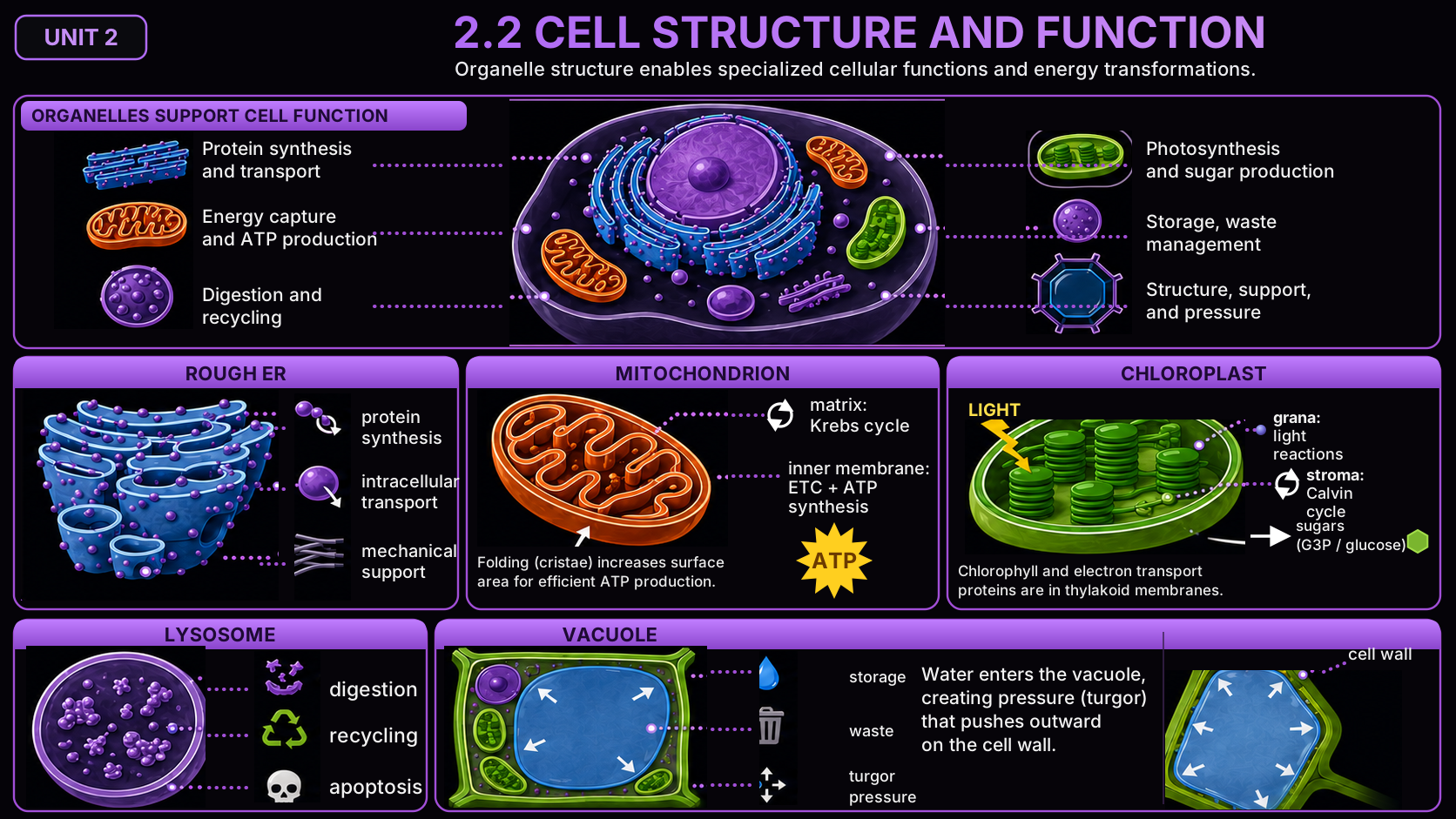
A cell is a collection of organelles, and every one of them earns its keep: its structure fits its function. Fold a membrane into a giant surface and you get a factory for making proteins; pack an interior with folded cristae and you get a power plant; wrap dangerous enzymes in a tough sac and you get safe recycling. Learn to read an organelle's shape and you can predict what it does — and, just as usefully, work backward from a job to the structure that must be doing it.
§1
The one big idea: structure fits function.
▸
The whole topic rests on a single principle: an organelle's structure is built for its function, and the two are so tightly matched that you can predict one from the other. Nothing about an organelle's shape is decoration — the folds, membranes, pores, and internal chemistry are each there because the job demands them.
Read it in both directions. Given a structure — say, a membrane folded into a huge internal surface studded with ribosomes — you can reason toward the function: lots of surface plus ribosomes means high-volume protein manufacturing (that is rough ER). And given a function — say, "this cell needs to burn a lot of fuel for energy" — you can reason toward the structure that must be doing it: mitochondria, and lots of them, packed with folded inner membrane.
This is exactly why muscle cells are crowded with mitochondria, why gland cells that secrete are stuffed with ER and Golgi, and why a leaf cell has chloroplasts a root cell does not. The organelles a cell builds, and how many, are a direct readout of what that cell does for a living. Keep asking “what is this shape for?” and the whole cell becomes readable.
§2
The information hub and the protein assembly line.
▸
Start with the organelles that store instructions and turn them into product. Each one's shape is a giveaway for its role.
- Nucleus — the vault for DNA. A double membrane (the nuclear envelope) riddled with nuclear pores wraps the cell's DNA. The pores are the tell: they let RNA and proteins pass while keeping the chromosomes protected inside. Structure (enclosed, pored compartment) fits function (protect the genome, control what gets in and out).
- Ribosomes — the workbenches that build proteins. Tiny, non-membrane-bound particles of RNA and protein. They read mRNA and link amino acids into proteins. Free ribosomes in the cytoplasm make proteins for use inside the cell; ribosomes on the rough ER make proteins for export or membranes.
- Rough ER — the studded factory floor. A network of membrane folded into a huge surface, coated with ribosomes (that is the “rough”). The vast studded surface fits its function: mass production and initial folding of proteins destined for secretion or the membrane.
- Smooth ER — the ribosome-free wing. Same membrane network, but no ribosomes. Its smooth surface carries the enzymes for a different job: synthesizing lipids, and detoxifying drugs and poisons (abundant in liver cells for exactly that reason).
- Golgi apparatus — shipping and receiving. A stack of flattened membrane sacs (cisternae). Proteins arrive from the ER in vesicles, get modified, tagged, and sorted, then leave in new vesicles addressed to their destination. The stacked, sequential structure fits its function: a step-by-step processing and dispatch line.
Notice the pattern across all five: more surface, more folding, or a specific coating always points to a specific manufacturing job. If you can name the structural feature, you can name the function.
§3
The organelles you'll meet.
▸
Quick reference card. For each organelle, read the structure and the function it fits — that pairing is the whole game.
§4
Power plants, recycling, storage, and scaffolding.
▸
The rest of the cell's organelles follow the same rule: each shape is fitted to a job. Read the structure, predict the function.
Mitochondria — the power plants. A mitochondrion has a double membrane, and the inner one is folded into deep ridges called cristae. Those folds pack an enormous amount of membrane surface into a small space — and it is on that surface that respiration builds ATP. More folding means more surface means more energy output, which is exactly why hard-working cells like muscle are crammed with mitochondria.
Chloroplasts — the solar panels. Found in plant and algal cells, a chloroplast holds stacks of flattened membrane discs (thylakoids) loaded with chlorophyll. The layered pigment surface is built to capture light and run photosynthesis. The structure — lots of light-catching membrane — is the function.
Lysosomes — safe demolition. A lysosome is a membrane sac filled with digestive enzymes that work best at acidic pH. Why a sac? The membrane keeps those powerful enzymes walled off from the rest of the cell, so waste and worn-out parts can be broken down without the enzymes chewing up the cell itself. The containment structure fits the recycling function.
Vacuoles — storage tanks. A vacuole is a membrane-bound space for storage. In plant cells the large central vacuole fills with water and pushes outward, creating turgor pressure that keeps the plant firm. Big empty-looking sac, simple job: hold things (water, ions, waste) and provide support.
Cell membrane — the gatekeeper. The plasma membrane is a phospholipid bilayer with embedded proteins. Its structure — a barrier that is selectively permeable — fits its function of controlling exactly what enters and leaves the cell. Structure and function again: no other arrangement would let a cell be both sealed and selective.
Cytoskeleton — the framework. A network of protein filaments and tubules runs through the cytoplasm. This scaffold gives the cell its shape and mechanical support and doubles as a set of internal tracks for moving organelles and vesicles around. A framework of fibers is exactly the structure you would design for support and transport.
Reading it backward. The principle works in reverse too. Told a cell secretes huge amounts of protein? Predict abundant rough ER and Golgi. Told a cell fights fatigue in flight muscle? Predict dense mitochondria with extensive cristae. Change the structure and the function changes with it — that is the heart of Topic 2.2.
§5
3 mistakes that cost real points.
▸
“An organelle's structure is just a shape — the function is a separate fact to memorize.”
This is the core misconception of the topic (the structure–function disconnect). Students treat “mitochondria have cristae” and “mitochondria make ATP” as two unrelated things to memorize, then can't answer any question that rewords either one. The folds are the reason for the ATP output — more folded surface, more respiration. The structure and the function are one idea, not two.
Fix. For every organelle, force yourself to say the link out loud: “this shape does this job because…” If you can't finish the sentence, you don't understand it yet — you've only memorized two labels.
“I can't predict the function from an unfamiliar structure.”
Exams love to describe an organelle's structure and ask what it does, or show a cell packed with one organelle and ask what the cell specializes in. If you only memorized names, you're stuck. But structure is predictive: lots of folded internal membrane → high-throughput chemistry (energy or synthesis); a sealed sac of enzymes → safe digestion; pores in a membrane → controlled traffic.
Fix. When you meet a structure you don't recognize, reason from features: more surface means more reactions; a membrane means separation and control; filaments mean support or movement. The shape tells you the job.
“A cell's job doesn't tell me anything about which organelles it has.”
The link runs backward too, and students forget it. A cell that secretes tons of protein must be rich in ribosomes, rough ER, and Golgi; a cell doing heavy mechanical work must be dense with mitochondria; a photosynthetic cell must have chloroplasts. Function predicts structure just as reliably as structure predicts function.
Fix. When a question gives you a cell's role, ask “what structure would that job require?” and name the organelles before you look at the choices. Structure and function are two views of the same fact.
§6
Skill Check.
▸
Ten scenarios. Pick the chips that match your answer, then check. A scenario marks complete the first time every part is right. Progress saves on this device.