 Mistake Master
Origins of cell compartmentalization
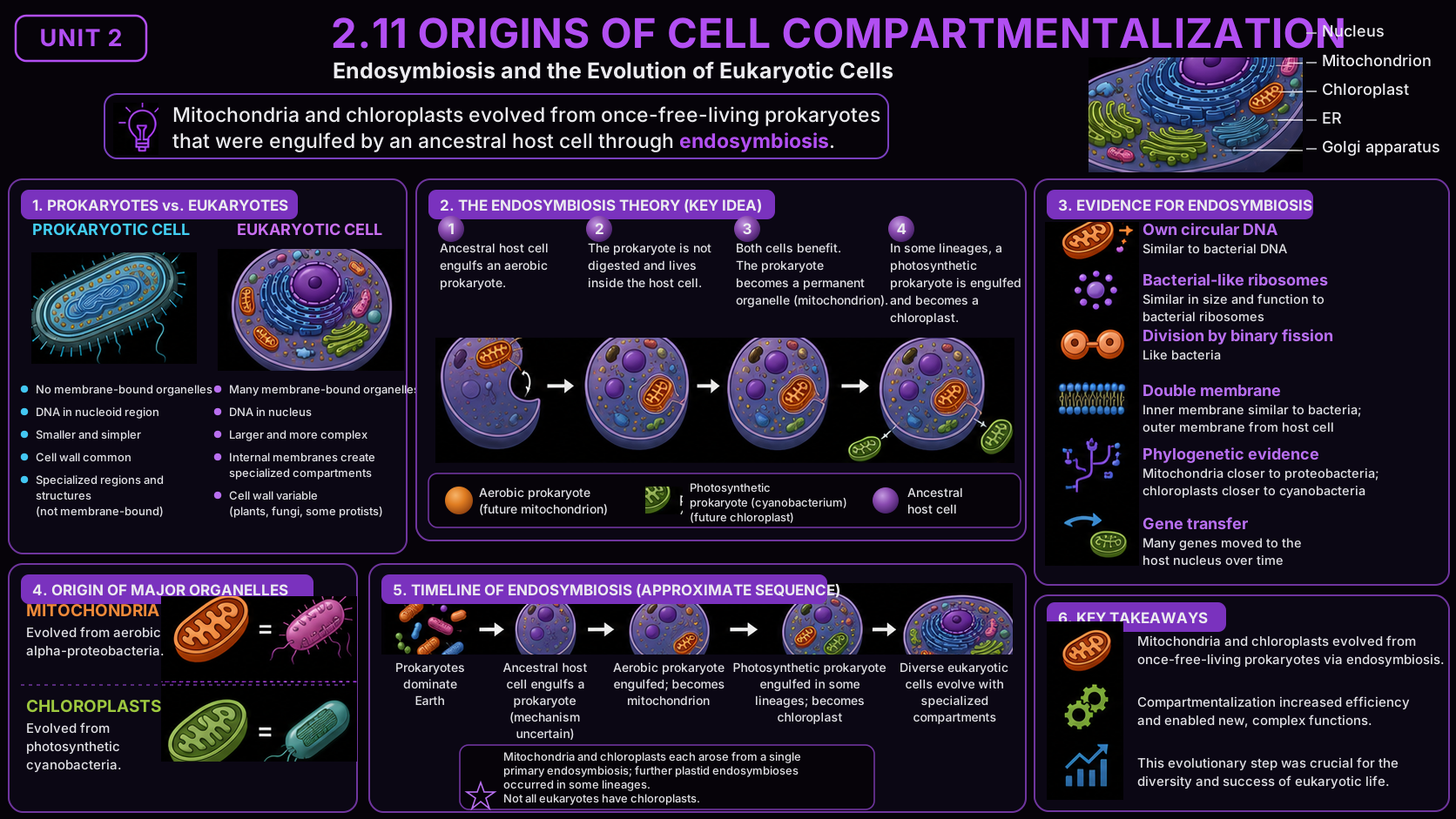
Two organelles have a stranger backstory than the rest. Mitochondria and chloroplasts did not grow out of the cell that houses them — they moved in. Billions of years ago a host cell engulfed free-living prokaryotes that were never digested; instead they stayed, divided, and became permanent residents. That is the endosymbiotic theory, and the evidence is still written into these organelles today: their own circular DNA, their own ribosomes, a telltale double membrane, and division that looks just like bacterial binary fission. The rest of the internal membranes — ER, Golgi, the nuclear envelope — have a different origin entirely.
§1
The one big idea: some organelles were once free-living cells.
▸
The whole topic rests on a single, surprising claim: mitochondria and chloroplasts began as independent prokaryotes that a larger host cell swallowed but did not digest. Instead of being broken down for food, those engulfed cells survived inside the host, kept reproducing, and gradually became permanent, working parts of it. This is the endosymbiotic theory — endo (inside) plus symbiosis (living together).
Picture the sequence. An ancient host cell takes in a small aerobic (oxygen-using) prokaryote. Rather than digesting it, the host keeps it — and the arrangement pays off: the engulfed cell supplies energy from respiration, the host supplies shelter and raw materials. Over enormous stretches of time the resident becomes the mitochondrion. In one lineage, a separate engulfment of a photosynthetic prokaryote gave rise to the chloroplast, which is why plants and algae have both and animals have only mitochondria.
The reason this idea sticks is that these two organelles still carry the fingerprints of their bacterial past. They keep their own DNA, build their own proteins, are wrapped in two membranes, and multiply on their own inside the cell. Read those features and the history reads right off them — that is the heart of Topic 2.11.
§2
The four fingerprints: evidence for endosymbiosis.
▸
Endosymbiosis is not a guess — it rests on four features that mitochondria and chloroplasts share with free-living bacteria and with almost nothing else in the cell. Each one is a leftover from a life once lived on its own.
- Their own DNA — and it's circular. Mitochondria and chloroplasts carry their own genome, separate from the cell's nuclear DNA. And it is a single circular loop, exactly the way bacterial DNA is arranged — not the linear chromosomes packed inside the nucleus. A working organelle keeping its own bacterial-style genome only makes sense if it once was a bacterium.
- Their own ribosomes. These organelles build some of their own proteins on ribosomes they keep inside themselves — and those ribosomes are the small, prokaryotic type, more like a bacterium's than like the host cell's. An organelle that makes its own product on bacterial machinery is behaving like a resident cell, not like a fold of the host.
- A double membrane. Both are wrapped in two membranes. That is just what engulfment predicts: when the host cell took the prokaryote in, it pinched off a piece of its own membrane around it, giving an inner membrane (the original prokaryote's) and an outer membrane (from the host). Two membranes are the physical scar of being swallowed.
- They divide by themselves, like bacteria. Mitochondria and chloroplasts are not built fresh each time from a blueprint. They reproduce on their own by pinching in two — a process that mirrors bacterial binary fission — independently of when the whole cell divides. Self-division is exactly what a former free-living cell would still do.
Line the four up — circular DNA, own ribosomes, double membrane, binary-fission-style division — and they all point one way: these organelles descend from engulfed prokaryotes. No other organelle checks all four boxes.
§3
Two different origin stories.
▸
Quick reference card. The internal membranes of a eukaryotic cell come from two separate origins — endosymbiosis for a select pair, infolding of the plasma membrane for the rest. Sort every organelle into the right story.
§4
The other origin: infolding of the plasma membrane.
▸
Endosymbiosis explains only mitochondria and chloroplasts. Every other internal membrane — the endoplasmic reticulum, the Golgi apparatus, and the nuclear envelope — came from a completely different process: infolding of the plasma membrane. The cell's outer membrane pushed inward, pinched off, and elaborated into an interior system of compartments. No cell was ever swallowed to make these.
The nuclear envelope — folded in around the DNA. The double membrane that surrounds the nucleus formed as the plasma membrane infolded and wrapped the cell's genetic material. Note the key contrast: even though it is a double membrane, it has no genome of its own and no bacterial ribosomes — because it was never a separate organism. Its two membranes come from folding, not from engulfment.
The endoplasmic reticulum — an internal membrane network. The ER is a continuous system of membrane channels that grew from the same infolding. It extends the cell's membrane surface inward for making proteins and lipids, but it is part of the host cell's own membrane — not a former prokaryote. It carries no circular DNA of its own.
The Golgi apparatus — from the same membrane system. The Golgi's stacked sacs are built from the endomembrane/vesicle system that traces back to infolding, not to endosymbiosis. It is bounded by a single membrane, another sign it did not arise from an engulfed cell.
The line that matters. Two origins, cleanly split. Endosymbiosis gave the cell mitochondria and chloroplasts — and only those. Infolding of the plasma membrane gave the ER, Golgi, and nuclear envelope. The tempting mistake is to stretch the infolding story to cover mitochondria and chloroplasts too — but their circular DNA, own ribosomes, double membrane, and self-division rule that out. Keep the two origins separate and Topic 2.11 falls into place.
§5
3 mistakes that cost real points.
▸
“All the organelles, mitochondria and chloroplasts included, evolved from membrane folds.”
This is the signature misconception of the topic (U2-BIO18). It is half right: the ER, Golgi, and nuclear envelope really did arise from infolding of the plasma membrane. The error is extending that same story to mitochondria and chloroplasts — those two did not come from membrane folds. They arose by endosymbiosis: engulfed free-living prokaryotes that stayed. Their circular DNA, own ribosomes, double membrane, and binary-fission-like division are exactly what a membrane fold would not have.
Fix. Keep two buckets. Infolding → ER, Golgi, nuclear envelope. Endosymbiosis → mitochondria and chloroplasts, and only those. If an organelle has its own DNA and divides by itself, it was a cell, not a fold.
“A double membrane by itself proves an organelle was once a bacterium.”
The double membrane is strong evidence, but it is not the whole case, and it is not unique to endosymbionts — the nuclear envelope is a double membrane too, and it came from infolding. What actually clinches endosymbiosis is the full set of fingerprints together: circular DNA, prokaryote-type ribosomes, the double membrane, and self-division. Lean on any single feature and a question can trip you.
Fix. Cite the evidence as a package. When asked why we think mitochondria and chloroplasts were once free-living cells, list all four: own circular DNA, own ribosomes, double membrane, and bacteria-like binary fission.
“Every plant and animal cell got its mitochondria and chloroplasts the same way.”
Students blur the two engulfment events. Mitochondria trace to the engulfment of an aerobic (respiring) prokaryote, and essentially all eukaryotes have them. Chloroplasts trace to a separate, later engulfment of a photosynthetic prokaryote, which is why only plants and algae carry them — animals never took up that second resident.
Fix. Remember the order and the reason for the split: aerobic prokaryote → mitochondrion (everyone), then a photosynthetic prokaryote → chloroplast (plants and algae only). Two engulfments, not one.
§6
Skill Check.
▸
Ten scenarios. Pick the chips that match your answer, then check. A scenario marks complete the first time every part is right. Progress saves on this device.