
Nucleic Acids
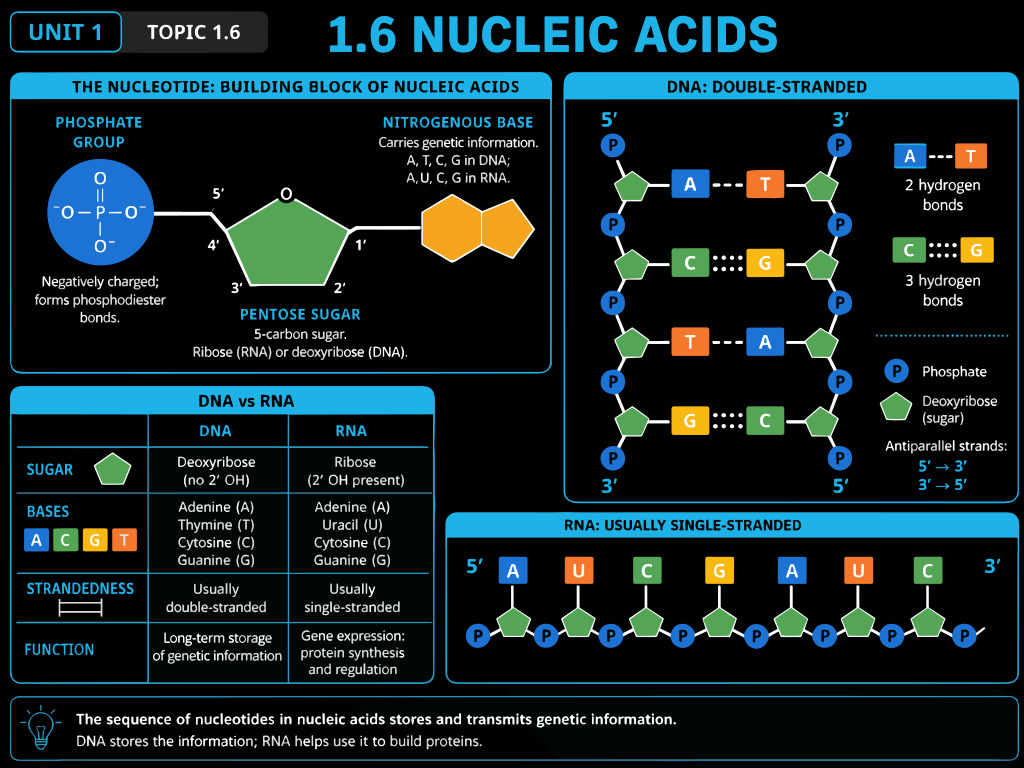
▶︎ Watch it animatedinteractive step-through · ~3 min · optionalA nucleic acid is a chain of nucleotides, and every nucleotide is built from the same three parts: a five-carbon sugar, a phosphate group, and a nitrogenous base. The sugar and phosphate of one nucleotide link to the sugar and phosphate of the next, over and over, forming a repeating sugar–phosphate backbone. That backbone is structural — it is the same all the way down, so it carries no message. The information lives in the one part that changes from rung to rung: the sequence of bases. Read the order of the bases and you read the code; the backbone just holds them in line.
Two strands come together by complementary base pairing. In DNA, adenine pairs only with thymine and guanine only with cytosine (A–T, G–C); RNA uses uracil in place of thymine, so there A pairs with U. The pairs are held by hydrogen bonds — the same kind of weak attraction that networks water, not the covalent bonds that build the backbone — which is exactly why the two strands can be unzipped for copying without breaking either chain apart. And the strands run antiparallel: one is oriented 5′→3′ while its partner runs 3′→5′. That opposite directionality is not a detail — base pairing only works when the strands point in opposite directions, and it sets the direction in which the molecule is read and copied.
Interactive · Nucleotide Builder
Assemble a nucleotide from its sugar, phosphate, and base, build a strand, then pair a complementary strand running the opposite way. Watch the backbone stay fixed while the base sequence carries the information.
Nucleotide Builder · Open the full sandbox →The common mistakes here are rarely about facts and mostly about causes. They come from expecting the sugar–phosphate backbone to spell out the message when it is the base sequence that does, from pairing bases at random instead of by their complements, from ignoring the antiparallel 5′→3′ directionality that makes those pairs fit, and from calling the hydrogen bonds between strands "covalent" as if unzipping DNA meant tearing the backbone. Each is a slip in why the molecule works the way it does — the structure–function link — not in what it is.
The work
3 ways in · any order
Lesson
Nucleic Acids
›
Nucleotide parts, the sugar–phosphate backbone versus the base sequence, complementary pairing, and antiparallel strands all follow from how the pieces fit. The lesson walks the ways students confuse the backbone with the message and mistake the causes, then closes with a ten-scenario applet: trace each function back to structure and say what it is that makes a nucleic acid store and copy information.
Diagnostic
10-item topic check
›
Ten items spanning this topic's active misconceptions: the sugar–phosphate backbone assumed to carry the information instead of the base sequence (BIO15), bases paired at random rather than by their complements and strands read as parallel rather than antiparallel (BIO14), the 5′→3′ directionality ignored (BIO11), plus the structure–function slips catalogued as BIO1, BIO2, and BIO4. Take it cold to surface which ones are still tangled, or after the lesson to confirm they aren't.
Targeted Practice
Drill a single misconception
›
Pick one of the failure modes you missed and drill it on its own. The round is adaptive: two correct in a row clears the misconception and moves you to the next.