
Introduction to Biological Macromolecules
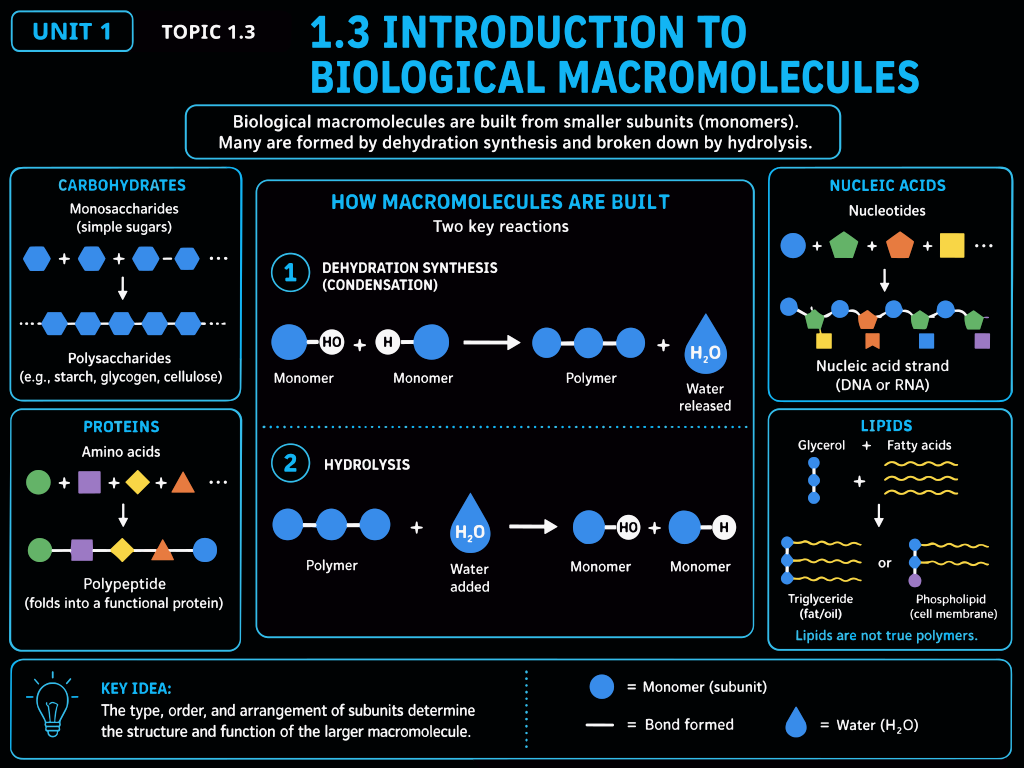
▶︎ Watch it animatedinteractive step-through · ~3 min · optionalAlmost every large molecule in a cell is built the same way: from small repeating units strung together into long chains. The small unit is a monomer; the chain built from many of them is a polymer. The individual monomers in a chain are its subunits — a polymer is not a new kind of matter, it is its subunits joined in sequence, and the identity and order of those subunits is what makes one polymer different from another.
Cells join monomers by dehydration synthesis: forming the bond removes a molecule of water — one monomer gives up an —OH, its neighbor gives up an —H, and together those make the water that leaves. The reverse, hydrolysis, adds water back to break a bond, splitting the polymer into its monomers. Synthesis costs energy and expels water; digestion consumes water and releases it. Same bond, opposite directions.
Interactive · Monomer → Polymer
Link monomers into a polymer and watch a water molecule leave at every new bond; run it backward and watch hydrolysis add water to break the chain apart. Structure builds on the left, the water ledger tracks on the right.
Monomer → Polymer · Open the full sandbox →Four classes of macromolecule run a cell, and three of them are polymers: carbohydrates are polymers of monosaccharides, proteins are polymers of amino acids, and nucleic acids are polymers of nucleotides. The fourth class, lipids, is the exception — a lipid is not a polymer, because its parts (a glycerol and its fatty acids) are not repeating identical subunits linked into a chain. Grouping lipids with the polymers is one of the most common slips in this topic.
Why the sequence of subunits matters is the whole point: structure predicts function. Twenty amino acids can be ordered into countless proteins, and the order fixes how the chain folds, which fixes what the protein can do. Read a monomer's identity or a chain's arrangement and you can predict the molecule's behavior — the same structure-function logic that runs through all of biology, now at the scale of a single chain.
The work
3 ways in · any order
Lesson
Introduction to Biological Macromolecules
›
Monomers, polymers, and the four macromolecule classes, built on one idea: chains of repeating subunits assembled by removing water and taken apart by adding it. The lesson works the ways students reverse dehydration and hydrolysis, mislabel lipids as polymers, and lose the subunit-to-polymer relationship, then closes with a ten-scenario applet that ties each class back to its monomer.
Diagnostic
10-item topic check
›
Ten items spanning this topic's active misconceptions: dehydration synthesis and hydrolysis run backward on which way water moves, lipids grouped in with the true polymers, and the subunit-to-polymer relationship read the wrong way. Take it cold to surface which ones are still tangled, or after the lesson to confirm they aren't.
Targeted Practice
Drill a single misconception
›
Pick one of the failure modes you missed and drill it on its own. The round is adaptive: two correct in a row clears the misconception and moves you to the next.