 Mistake Master
Nucleic acids
DNA and RNA are long chains of one repeating monomer — the nucleotide — and almost everything that matters about them comes down to one idea: the sequence of bases is the message, while the sugar-phosphate backbone is just the string it is written on. Get the parts of a nucleotide, complementary base pairing, and the two very different bonds straight, and heredity stops being magic and starts being structure.
§1
What a nucleotide is made of.
▸
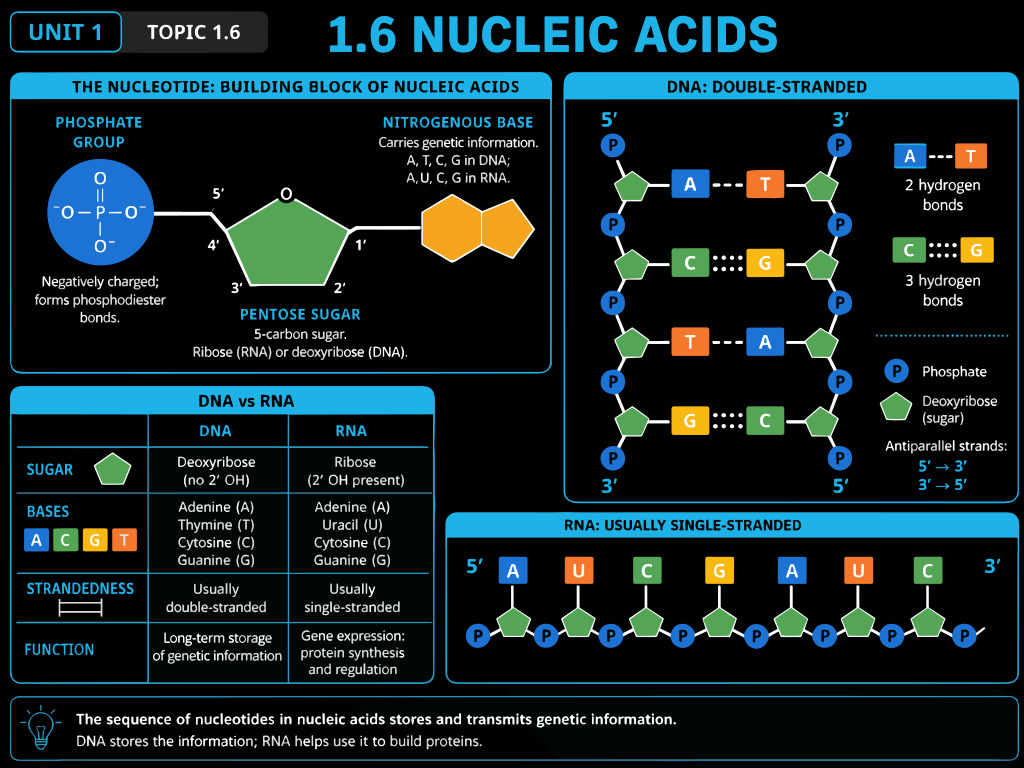
A nucleic acid — DNA or RNA — is a polymer, and its monomer is the nucleotide. Every nucleotide is built from exactly three parts joined together: a five-carbon sugar (deoxyribose in DNA, ribose in RNA), one or more phosphate groups, and a nitrogenous base. Learn those three parts and you have the entire alphabet of heredity.
Two of those parts never change from one nucleotide to the next: the sugar and the phosphate are identical in every nucleotide. It is only the base that varies. DNA uses four bases — adenine (A), thymine (T), guanine (G), and cytosine (C); RNA swaps thymine for uracil (U). Because the sugar and phosphate are always the same, they are simply the structural frame; the base is the one part that can spell out a message.
When nucleotides link into a strand, the phosphate of one joins the sugar of the next, over and over, forming a repeating sugar-phosphate backbone with the bases hanging off to the side. Here is the single most important idea in the whole topic: the backbone is a uniform, monotonous rail — sugar, phosphate, sugar, phosphate — and it carries no information. The genetic information lives entirely in the order of the bases strung along that rail. Changing the sequence of bases changes the message; the backbone stays the same either way.
§2
Two very different bonds hold a double helix together.
▸
This is the single most important bonding distinction in the topic, and the one that trips up the most students. A DNA double helix is held together by two completely different kinds of bond, and they are not the same thing.
- Covalent phosphodiester bonds — along each backbone. Within one strand, each sugar is joined to the next phosphate by a strong covalent bond. This is what links the monomers into a chain, exactly like the bonds that build any polymer, and it forms by dehydration (a water molecule is removed for each bond). These bonds are strong; they do not come apart when the helix is read or copied.
- Hydrogen bonds — between the two strands. The two strands are held to each other only by hydrogen bonds between paired bases — two between A and T, three between G and C. Any one of these is weak, far weaker than a covalent bond, which is exactly the point: the helix can be “unzipped” down the middle to read or replicate it without ever breaking the backbone.
So the geometry has a job for each bond. The strong covalent backbone keeps each strand intact and permanent; the weak hydrogen bonds between bases let the two strands separate easily and rejoin. Reverse them — imagine covalent bonds gluing the bases together — and DNA could never be read. Keep “backbone = covalent (strong), base pairs = hydrogen bonds (weak)” straight and most Unit 1 nucleic-acid traps fall apart.
§3
The terms you'll meet.
▸
Quick reference card. Keep straight the parts of a nucleotide and the two kinds of bond in a helix.
§4
Base pairing, direction, and why the double helix works.
▸
Once you know a nucleotide is sugar + phosphate + base, the whole structure of DNA follows from a few rules about how the bases and strands fit together.
Complementary base pairing. Across the two strands, bases pair in a fixed way: A pairs with T, and G pairs with C (held by hydrogen bonds — two for A–T, three for G–C). Pairing is not random and it is not like-with-like: A does not pair with G, and C does not pair with T. In RNA the rule shifts slightly — RNA has no thymine, so it uses uracil (U), and U pairs with A.
Why complementarity matters. Because pairing is fixed, one strand completely specifies the other. If you know one strand reads A–T–G–C, its partner must read T–A–C–G. That is the entire secret to copying DNA: pull the strands apart and each one is a template for rebuilding its complement. Structure delivers function.
Antiparallel strands and 5′→3′ directionality. A strand is directional: because of how the sugar's carbons are numbered, one end of the backbone is the 5′ end and the other is the 3′ end, and new nucleotides can only be added to the 3′ end. In the double helix the two strands run antiparallel — one points 5′→3′ while its partner points 3′→5′. They are not two identical strands lined up the same way; they are opposite in direction, which is exactly what lets the bases line up to pair.
The backbone is a rail, not a message. It is tempting to think a longer or fancier backbone stores more information, but the sugar-phosphate backbone is monotonous and identical everywhere. All of the information — every gene, every instruction — is encoded in the sequence of bases, the way letters carry meaning while the paper they are printed on does not.
Structure → function. Two complementary, antiparallel strands zipped together by weak hydrogen bonds and reinforced by a strong covalent backbone give DNA everything it needs: it is stable enough to store information faithfully, yet it can be unzipped to be read and copied. Change the structure — scramble the pairing rules, glue the strands with covalent bonds, or try to store the message in the backbone — and the function collapses.
§5
3 mistakes that cost real points.
▸
“The sugar-phosphate backbone stores the genetic information.”
This is the signature error of the topic. The backbone is a repeating rail of sugar–phosphate–sugar–phosphate that is identical everywhere along the strand — it cannot spell out anything. The genetic information is carried entirely by the sequence of bases attached to that backbone. Two DNA molecules with the same backbone but different base orders carry completely different messages.
Fix. Think of the backbone as the paper and the base sequence as the writing. Change the writing (the base order) and the message changes; the paper is the same either way.
“Any base can pair with any base — and RNA uses thymine like DNA.”
Base pairing is fixed and specific: A pairs with T, G pairs with C, held together by hydrogen bonds. A does not pair with G, and C does not pair with T. And RNA does not contain thymine at all — it uses uracil (U) in thymine's place, and U pairs with A. Students routinely mix up the pairs or leave thymine in RNA.
Fix. Memorize the two purine–pyrimidine pairs: A–T and G–C (A–U in RNA). If you ever write A–G or C–T, or put thymine in RNA, stop — it is wrong.
“A strand has no direction, and the two strands run the same way.”
Each strand is directional, with a distinct 5′ end and 3′ end; nucleotides are only added at the 3′ end. The two strands of a helix are antiparallel — one runs 5′→3′ while the other runs 3′→5′. They are not two identical strands laid down in the same orientation; running opposite directions is what lets the bases line up and pair.
Fix. Always label the ends 5′ and 3′, and draw the partner strand pointing the opposite way. “Antiparallel” means opposite directions, not just “two strands.”
§6
Skill Check.
▸
Ten scenarios. Pick the chips that match your answer, then check. A scenario marks complete the first time every part is right. Progress saves on this device.