
Elements of Life
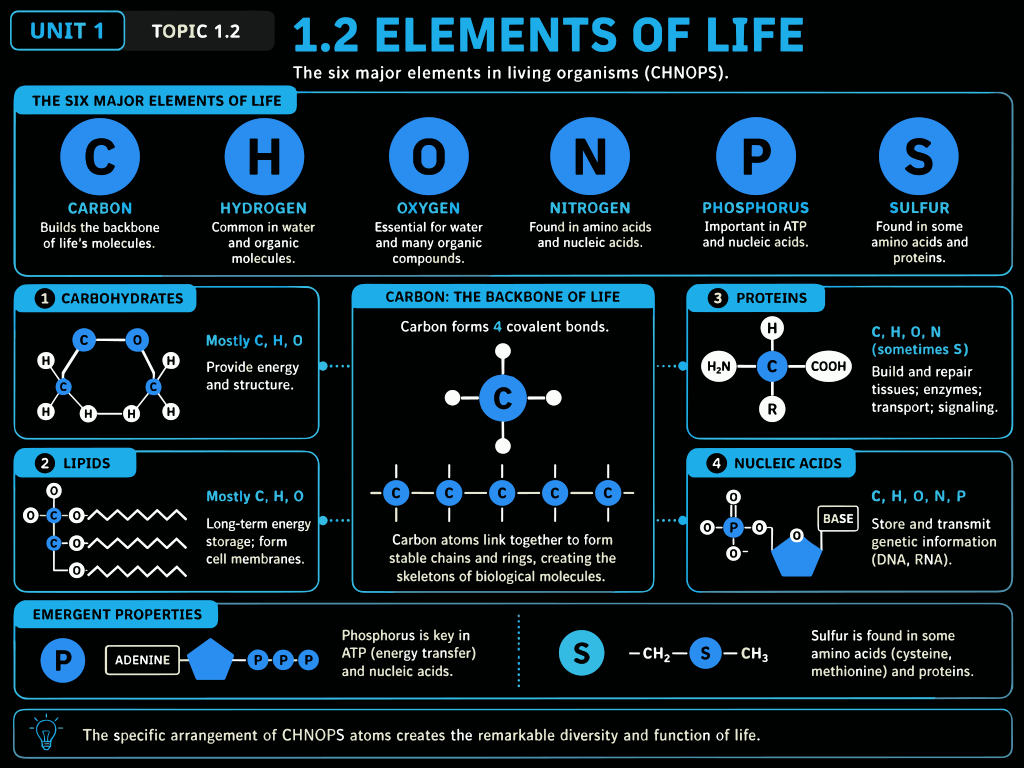
▶︎ Watch it animatedinteractive step-through · ~3 min · optionalAlmost everything a cell is built from comes down to just six elements: carbon, hydrogen, nitrogen, oxygen, phosphorus, and sulfur — CHNOPS. Carbon is the backbone. With four valence electrons, a carbon atom forms four covalent bonds, which lets it link into long chains, branches, and rings and still have bonds left over to hang other atoms off of. That single fact — four bonds per carbon — is why life's molecules can be so large and so varied while resting on the same skeleton.
But the carbon skeleton mostly just holds things in place. What a molecule does is set by its functional groups — small clusters of atoms attached to that skeleton. A hydroxyl (–OH) makes a region polar and water-loving; a carboxyl (–COOH) can release a proton, making the molecule acidic; an amino (–NH₂) can accept one, making it basic; a phosphate carries negative charge and stores usable energy. Swap the group and you change the polarity, acidity, and reactivity — even when the carbon chain underneath is identical. Structure explains function, and here the function lives in the groups.
Interactive · Element Builder
Build up a carbon skeleton, attach functional groups, and watch polarity, acidity, and reactivity change as you swap them. The skeleton holds the shape; the groups decide the behavior.
Element Builder · Open the full sandbox →The common mistakes here are rarely about naming the elements and mostly about what "organic" and "reactive" actually mean. The word organic means carbon-based — it says nothing about whether a molecule is natural, healthy, or safe; a lab-made carbon compound is every bit as organic as one from a plant (U1-BIO8). And it is a slip to treat the carbon skeleton as the thing that makes a molecule acidic, basic, or water-loving: two molecules with the same skeleton behave completely differently once their functional groups differ, because the groups — not the carbon chain alone — set polarity, acidity, and reactivity (U1-BIO9).
The work
3 ways in · any order
Lesson
Elements of Life
›
The CHNOPS elements, carbon's four bonds and the chains and rings they build, and the functional groups that decide polarity, acidity, and reactivity. The lesson walks the ways students misread "organic" and pin behavior on the carbon skeleton, then closes with a ten-scenario applet: change the group, predict how the molecule behaves, and say why.
Diagnostic
10-item topic check
›
Ten items spanning this topic's active misconceptions: "organic" read as natural or healthy rather than carbon-based (U1-BIO8), and behavior — polarity, acidity, reactivity — pinned on the carbon skeleton instead of the functional groups that actually set it (U1-BIO9). Take it cold to surface which ones are still tangled, or after the lesson to confirm they aren't.
Targeted Practice
Drill a single misconception
›
Pick one of the failure modes you missed and drill it on its own. The round is adaptive: two correct in a row clears the misconception and moves you to the next.