
Structure of Water and Hydrogen Bonding
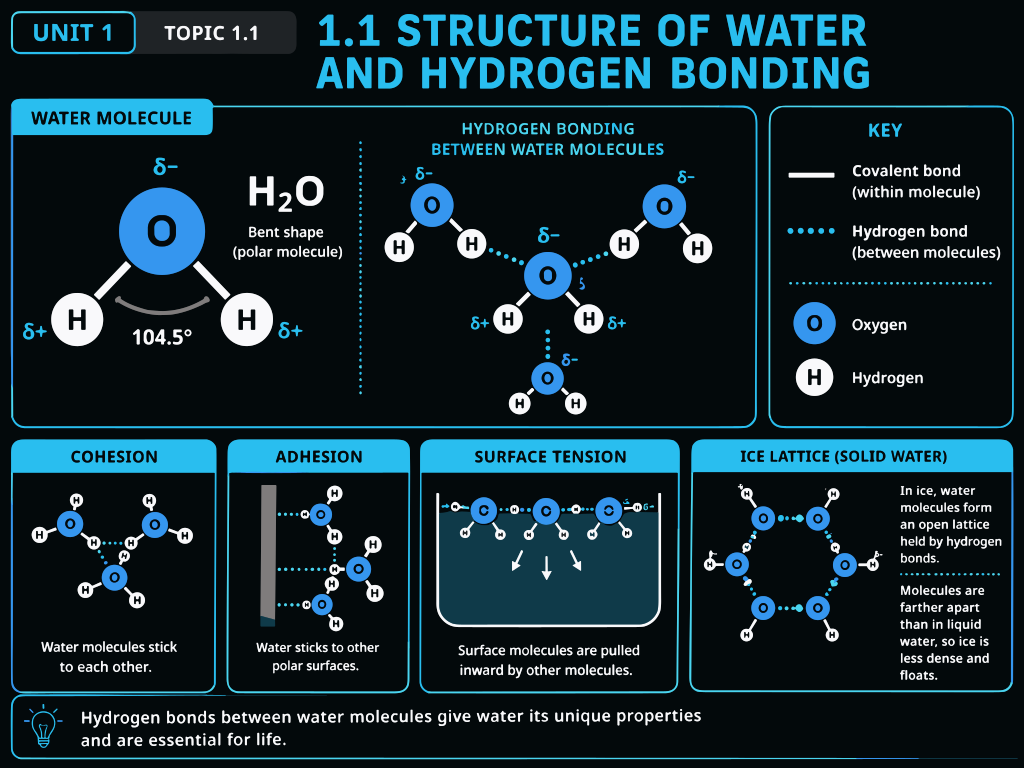
▶︎ Watch it animatedinteractive step-through · ~3 min · optionalA water molecule is just two hydrogens bonded to one oxygen, but its shape decides everything. Oxygen pulls the shared electrons harder than hydrogen does, and because the molecule is bent rather than straight, that pull does not cancel — one end carries a slight negative charge, the other a slight positive. Water is polar. The strong bonds holding each molecule together are covalent; the far weaker attractions between neighboring molecules, where a positive hydrogen reaches toward a negative oxygen, are hydrogen bonds.
No single hydrogen bond amounts to much, yet a whole network of them — forming and breaking billions of times a second — gives water its outsized behavior: cohesion and surface tension, a high heat capacity that buffers temperature, capillary action, and its reach as the near-universal biological solvent. When water freezes, those same bonds lock the molecules into an open lattice that is less dense than liquid water, so ice floats and ponds freeze from the top down. These are emergent properties: they belong to the collection, not to any one molecule, and each traces straight back to the molecule's structure. Structure explains function.
Interactive · Water Lab
Build the molecule, watch polarity emerge from its bent shape, and see the hydrogen-bond network give water its properties. Structure on the left, function on the right.
Water Lab · Open the full sandbox →The common mistakes here are rarely about facts and mostly about causes. They come from calling the covalent bond inside a water molecule the same thing as the hydrogen bond between molecules, from expecting a bent, polar molecule to behave like a symmetric one, from treating water's large-scale properties as if a single molecule possessed them, and from assuming a frozen solid must be denser than its liquid. Each is a slip in why water behaves as it does — the structure–function link — not in what it does.
The work
3 ways in · any order
Lesson
Structure of Water and Hydrogen Bonding
›
Water's polarity, hydrogen bonding, and emergent properties all follow from one bent molecule. The lesson walks the ways students confuse the bonds and mistake the causes, then closes with a ten-scenario applet: trace each property back to structure and say what it is that makes water behave the way it does.
Diagnostic
10-item topic check
›
Ten items spanning water's active misconceptions: a covalent bond confused with a hydrogen bond, polarity mistaken for molecular geometry, emergent properties pinned on a single molecule, ice assumed to be denser than liquid water, and function read without its structural cause. Take it cold to surface which ones are still tangled, or after the lesson to confirm they aren't.
Targeted Practice
Drill a single misconception
›
Pick one of the failure modes you missed and drill it on its own. The round is adaptive: two correct in a row clears the misconception and moves you to the next.