
Properties of Biological Macromolecules
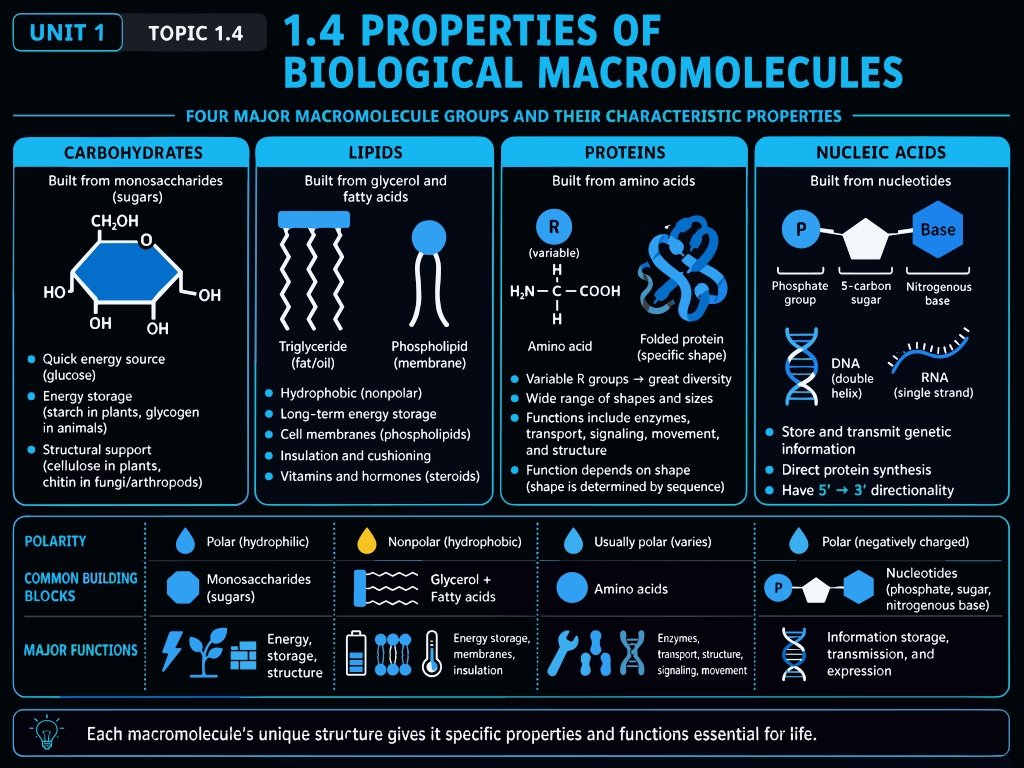
▶︎ Watch it animatedinteractive step-through · ~3 min · optionalA macromolecule's job is written in its arrangement, not its ingredient list. Two molecules can carry the exact same molecular formula — the same count of every atom — and still be entirely different substances that do entirely different jobs, because those atoms are put together differently. These are isomers: same formula, different structure, different function (U1-BIO10). Glucose and fructose both read C6H12O6, yet one is an aldose and the other a ketose (its carbonyl group sits mid-chain rather than at the end) with a different taste, reactivity, and metabolic fate. And the functional groups hung on a carbon skeleton — hydroxyl, carboxyl, amino, phosphate — are what tune a molecule's polarity, acidity, and reactivity; swap the group and the behavior changes even when the skeleton does not (U1-BIO9).
Polymers add a second layer of structure: order and direction. Cells build them by dehydration synthesis, removing a water molecule to link each monomer, and take them apart by hydrolysis, adding water back to break the bond (U1-BIO2) — and each class pairs with its own kind of monomer, so proteins are chains of amino acids and nucleic acids are chains of nucleotides, never the other way around (U1-BIO3). Crucially, these chains have directional ends. A protein runs from its amino (N) terminus to its carboxyl (C) terminus; a nucleic acid runs 5′ → 3′. Because the two ends are chemically different, the sequence must be read one way — the same monomers in reverse spell a different molecule (U1-BIO11). Directionality is information.
Interactive · Directionality Explorer
Read a polymer with its direction respected, then flip it, reverse it, or pair an antiparallel strand and watch the molecule change. Compare isomers that share a formula, and swap a functional group to see the chemistry shift. Structure sets the function.
Directionality Explorer · Open the full sandbox →The common mistakes here are rarely about naming the parts and mostly about why the parts matter. They come from treating two isomers as interchangeable because a formula matches — forgetting that arrangement, not atom count, sets identity — from reading a directional chain backward as if a polymer were symmetric, from pinning a molecule's chemistry on its carbon skeleton rather than its functional groups, and from losing track of how dehydration and hydrolysis add or remove water to build and break the bonds. Every one is a slip in the structure–function link — the single idea that a biological molecule does what it does because of how it is built (U1-BIO1).
The work
3 ways in · any order
Lesson
Properties of Biological Macromolecules
›
Isomers that share a formula but not a function, functional groups that tune behavior, and the directionality that makes a polymer's sequence readable only one way. The lesson walks the ways students mistake same-formula for same-molecule and read a chain backward, then closes with a ten-scenario applet: flip, reverse, and re-group a molecule, and say why the change matters.
Diagnostic
10-item topic check
›
Ten items spanning this topic's active misconceptions: same formula read as the same molecule (U1-BIO10), a directional polymer read backward as if it were symmetric (U1-BIO11), chemistry pinned on the carbon skeleton instead of the functional groups (U1-BIO9), dehydration and hydrolysis muddled (U1-BIO2), monomer–polymer pairings crossed (U1-BIO3), and function read without its structural cause (U1-BIO1). Take it cold to surface which ones are still tangled, or after the lesson to confirm they aren't.
Targeted Practice
Drill a single misconception
›
Pick one of the failure modes you missed and drill it on its own. The round is adaptive: two correct in a row clears the misconception and moves you to the next.