
Structure and Function of Biological Macromolecules
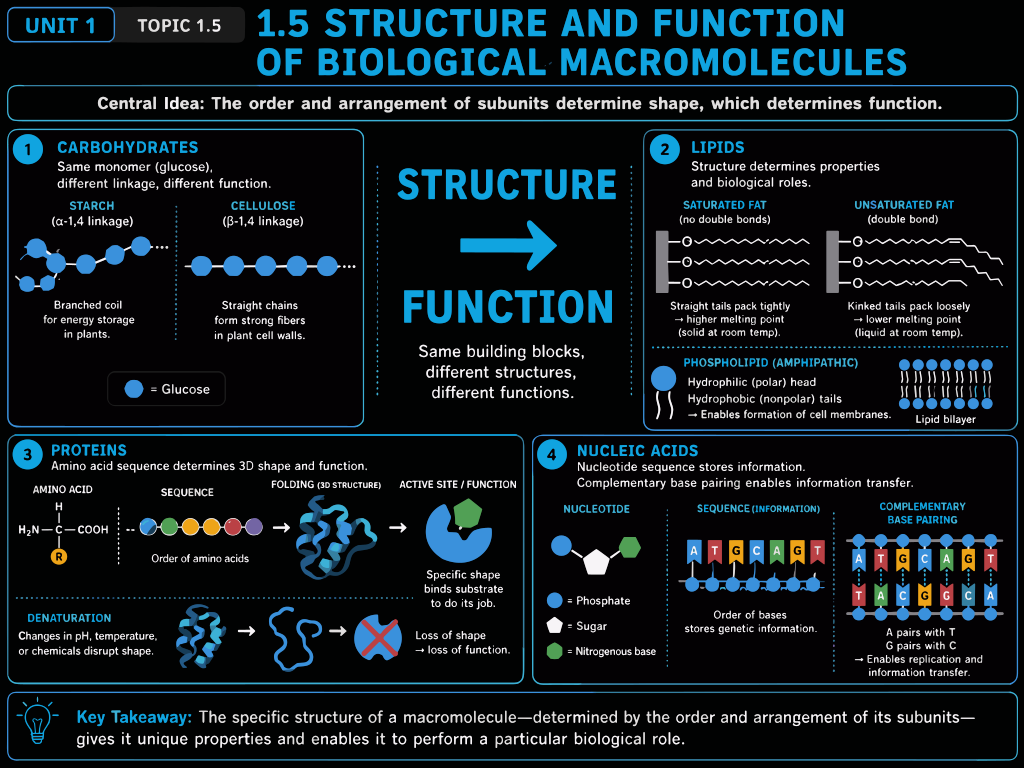
▶︎ Watch it animatedinteractive step-through · ~3 min · optionalA protein starts as a chain — amino acids linked one after another by covalent peptide bonds. That linear order, the primary structure, is the sequence, and it is not the shape. The sequence is only the instruction. What makes a protein do anything is how the chain folds into a specific three-dimensional form, and folding is driven not by the backbone but by the R-groups — the side chains — reaching for each other and for water.
The folding happens in levels. Local stretches of the backbone twist into secondary structure — alpha helices and beta pleated sheets — held by hydrogen bonds along the chain. The whole chain then collapses into a compact tertiary structure, its overall 3-D shape, pinned by interactions between R-groups: hydrogen bonds, ionic attractions, hydrophobic clustering away from water, and the occasional strong disulfide bridge. When two or more folded chains assemble into one working unit, that is quaternary structure. Every level above the first is the sequence expressing itself in space — the same string of amino acids could not function until it folded.
Interactive · Protein Folder
Lay down the amino-acid sequence, then watch R-group interactions and hydrogen bonds fold the chain through its secondary, tertiary, and quaternary levels into the 3-D shape that does the work. Sequence on the left, function on the right.
Protein Folder · Open the full sandbox →This is where denaturation is misread. Heat, pH, or salt can unravel a protein and destroy its function — but what breaks are the weak higher-order interactions, the hydrogen bonds and R-group attractions holding the fold together. The covalent peptide backbone survives; the primary sequence is still intact. A denatured protein has lost its shape, not its amino acids. And because shape is what determines what a molecule can bind and catalyze, the whole logic runs one way: structure explains function. Change the fold and you change the job, even when every amino acid is exactly where it started.
The work
3 ways in · any order
Lesson
Structure and Function of Biological Macromolecules
›
A protein's amino-acid sequence is the instruction, not the shape. The lesson walks the four levels of protein structure, the R-group interactions and hydrogen bonds that fold the chain, and why denaturation destroys the fold while leaving the peptide backbone whole — then closes with a ten-scenario applet: trace each function back to the folded structure that makes it possible.
Diagnostic
10-item topic check
›
Ten items spanning this topic's active misconceptions: the amino-acid sequence mistaken for the protein's shape (BIO13), denaturation assumed to break the primary structure or peptide backbone (BIO12), plus the structure–function slips catalogued as BIO1, BIO2, BIO4, and BIO9. Take it cold to surface which ones are still tangled, or after the lesson to confirm they aren't.
Targeted Practice
Drill a single misconception
›
Pick one of the failure modes you missed and drill it on its own. The round is adaptive: two correct in a row clears the misconception and moves you to the next.