 Mistake Master
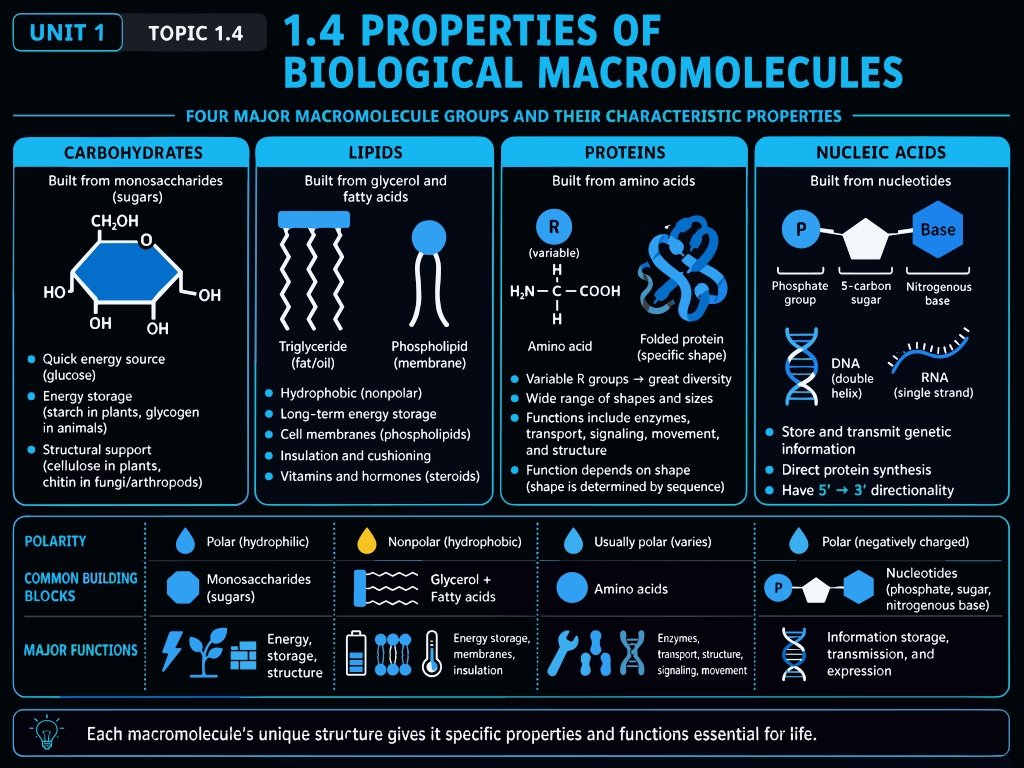
Properties of biological macromolecules
Two molecules can share the exact same chemical formula and still be completely different molecules with completely different jobs — that is the whole point of an isomer. And a polymer is not just a bag of monomers: it is a chain with a direction, a beginning and an end that the cell reads one way only. Add the small functional groups that decorate the backbone, and you can predict how a macromolecule behaves. Master isomers, directionality, and functional groups, and structure→function stops being a slogan and starts being a tool.
§1
Same formula is not the same molecule.
▸
Glucose and fructose share the identical molecular formula, C6H12O6. Count the atoms and they match exactly. Yet they are different molecules with different shapes, different chemistry, and different roles in the cell. A molecular formula is just an inventory of atoms; it does not tell you how those atoms are arranged — and arrangement is what makes a molecule what it is.
Molecules that share a formula but differ in arrangement are called isomers. There are two flavors you meet in AP Bio. Structural (constitutional) isomers connect the same atoms in a different order: glucose carries its carbonyl at the end of the chain (an aldose), fructose carries it in the middle (a ketose). Geometric (cis–trans) isomers connect the atoms in the same order but fix them in a different orientation around a rigid double bond — the difference between a cis and a trans fatty acid, for example.
Here is the part students miss: because the atoms are counted the same, it is tempting to treat isomers as interchangeable. They are not. A cis unsaturated fat kinks and stays liquid (a healthy oil); its trans isomer packs straight and behaves like a solid (a trans fat). Same formula, opposite behavior. The formula is the starting point, never the answer.
§2
Polymers have a direction.
▸
A polymer is not a symmetric string of beads you could read either way. Every biological polymer has two chemically different ends, so the chain has a built-in direction. The cell always builds and reads it the same way, and that convention carries real information — the sequence read forward means something different from the same sequence read backward.
- Proteins run N→C. Each amino acid has an amino end (–NH2, the “N-terminus”) and a carboxyl end (–COOH, the “C-terminus”). Peptide bonds link them into a chain that has a distinct N-terminus and C-terminus. The ribosome builds a protein N-terminus first, C-terminus last — always.
- Nucleic acids run 5′→3′. The sugar–phosphate backbone has a 5′ end (a free phosphate on the 5th sugar carbon) and a 3′ end (a free –OH on the 3rd). DNA and RNA polymerases add new nucleotides only to the 3′ end, so the strand is synthesized 5′→3′ and read in that convention.
Why it matters: the two ends are not interchangeable, so a sequence has an orientation. The peptide “Gly–Ala” is a different molecule from “Ala–Gly,” and the DNA strand 5′-ATG-3′ is not the same as 5′-GTA-3′. Ignore directionality and you will happily read a sequence backward and call it the same — a mistake the cell never makes.
§3
The terms you'll meet.
▸
Quick reference card. Keep straight what the atoms are versus how they are arranged and oriented.
§4
From functional groups to function.
▸
If isomers and directionality set the architecture of a macromolecule, functional groups set its chemistry. These are small, recurring clusters of atoms bolted onto the carbon backbone, and each one confers a predictable behavior no matter what molecule it sits on. Learn the handful of them and you can read a structure like a label.
Functional groups are not decoration. A carboxyl group (–COOH) makes a region acidic because it donates a proton. An amino group (–NH2) is basic because it accepts one. A hydroxyl (–OH) is polar and hydrogen-bonds with water, raising solubility. A phosphate group carries negative charge and stores transferable energy. Swap a hydroxyl for a carboxyl on the same skeleton and the molecule's acidity, polarity, and reactivity all change — the backbone is the frame, the groups are where the action is.
Dehydration builds, hydrolysis breaks — and water flows opposite ways. To link two monomers, the cell runs dehydration synthesis: it removes one water molecule per bond formed (an –OH from one monomer, an –H from the other). To take a polymer apart, it runs hydrolysis: it adds one water per bond broken, splitting the linkage. Same water, opposite direction. Building releases water; breaking consumes it. Reverse those and you invert every metabolic story in the unit.
Not everything large is a polymer. Carbohydrates, proteins, and nucleic acids are true polymers — long chains of repeating monomers. Lipids are the exception: a fat is a glycerol joined to fatty acids, not a repeating monomer chain, so “big macromolecule” does not automatically mean “polymer.” Don't overgeneralize the monomer–polymer rule to all four classes.
Structure → function, made concrete. Put the pieces together and the theme of the whole unit becomes usable: the arrangement of atoms (isomer), the orientation of the chain (directionality), and the functional groups attached all determine what a macromolecule does. Change any of them — move a carbonyl, flip a double bond from cis to trans, read a sequence backward, swap a functional group — and you change the function. That is why the formula alone never tells the whole story.
§5
3 mistakes that cost real points.
▸
“Same molecular formula means the same molecule.”
Glucose and fructose are both C6H12O6; a cis fat and its trans isomer share a formula too. But identical atom counts do not make identical molecules. Isomers differ in arrangement or orientation, and that difference changes their shape, chemistry, and biological job. The formula is an atom inventory, not an identity.
Fix. Treat a matching formula as a starting point, never a conclusion. Ask how the atoms are connected and oriented before deciding two molecules are the same — isomers prove that arrangement, not just composition, defines a molecule.
“A polymer reads the same forward and backward.”
Every biological polymer has two chemically different ends, so it has a direction. Proteins run N→C; nucleic acids run 5′→3′. That means “Gly–Ala” is not “Ala–Gly,” and 5′-ATG-3′ is not 5′-GTA-3′. Ignoring directionality lets you flip a sequence and wrongly call it equivalent.
Fix. Always note which end is which before reading or comparing a sequence. The cell synthesizes proteins N-terminus first and nucleic acids by adding to the 3′ end — the orientation is part of the information.
“Functional groups are just decoration on the backbone.”
The carbon skeleton is the frame, but the functional groups are where the chemistry lives. A carboxyl is acidic, an amino is basic, a hydroxyl is polar, a phosphate is charged and energy-rich. Two molecules with the same skeleton but different groups behave differently — treating the groups as irrelevant makes it impossible to predict solubility, acidity, or reactivity.
Fix. Read the functional groups first. They, not the size of the backbone, tell you how a molecule will act — and swapping one for another genuinely changes what the molecule does.
§6
Skill Check.
▸
Ten scenarios. Pick the chips that match your answer, then check. A scenario marks complete the first time every part is right. Progress saves on this device.