 Mistake Master
Introduction to biological macromolecules
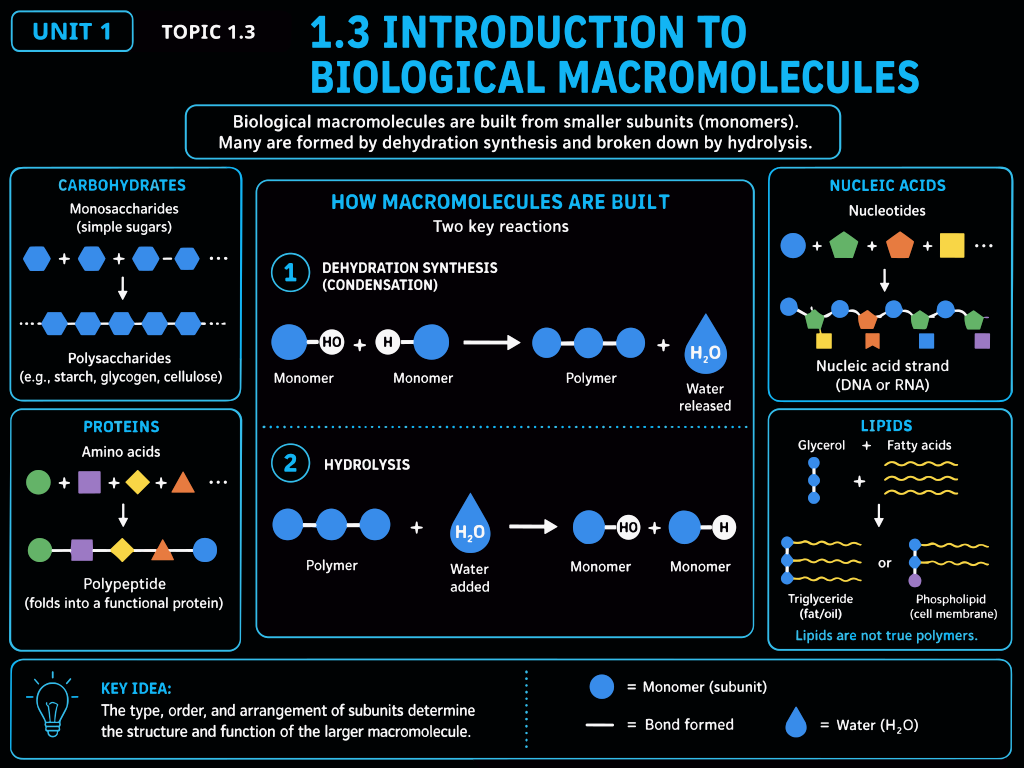
The giant molecules of life are built from small, repeating parts. Link many monomers together and you get a polymer; the cell builds those bonds by removing water and breaks them by adding water. Just four classes — carbohydrates, proteins, nucleic acids, and lipids — do nearly everything, yet only three of them are true polymers. Learn the monomer–polymer logic and the two reactions that assemble and dismantle it, and the whole unit clicks into place.
§1
Monomers and polymers: the building-block logic.
▸
The biggest molecules in a cell are not made in one piece. They are assembled the way a train is assembled — from many small, repeating cars. A single building-block unit is a monomer; a long chain of monomers linked together is a polymer. The word for one repeating unit is also called a subunit. A polymer built from thousands of monomers is a macromolecule — literally a “giant molecule.”
Here is the distinction students blur: a monomer is one subunit, and a polymer is the whole chain of them. A monomer is not just “any small molecule” — it is a small molecule that is built to link up with copies of itself into a chain. And a polymer is not a molecule made of one atom; it is a molecule made of many repeating monomers. Keep “monomer = one link, polymer = the chain” straight and half the vocabulary of this unit falls into place.
Because a polymer is a chain, the order and identity of its monomers can vary enormously. A handful of different monomers, strung in different sequences and lengths, produce a staggering diversity of polymers — which is exactly how a few kinds of amino acid can build every protein you own.
§2
Two reactions: build by removing water, break by adding water.
▸
This is the single most tested idea in the topic, and the one most students reverse. There are exactly two reactions, and they are opposites. Get their direction straight — which one removes water and which one adds it — and most Unit 1 macromolecule traps fall apart.
- Dehydration synthesis — builds the polymer by removing water. To join two monomers, the cell strips an –OH from one and an –H from the other, releasing them as a molecule of water (H2O). Losing that water is what lets the two monomers form a new covalent bond. Dehydrate = remove water; synthesis = build. Building a chain of n monomers forms n−1 bonds and releases about n−1 waters.
- Hydrolysis — breaks the polymer by adding water. To split a polymer back into monomers, the cell inserts a water molecule across the bond: the –OH goes to one monomer, the –H to the other, and the bond breaks. Hydro = water, lysis = splitting — “water splitting.” This is exactly what digestion does to the starch and protein you eat.
The trap is to memorize the words but flip the direction — to say dehydration adds water or hydrolysis removes it. Anchor it to the plain meaning of the prefixes: de-hydration removes water to build; hydro-lysis adds water to break. They are perfect opposites.
§3
The terms you'll meet.
▸
Quick reference card. Keep straight what is one unit versus the whole chain, and which reaction removes versus adds water.
§4
The four classes — and which are actually polymers.
▸
Almost everything a cell is built from and runs on belongs to just four classes of large biological molecule. Three of them are true polymers — chains of repeating monomers — and one is the important exception.
Carbohydrates. The monomer is a monosaccharide (a simple sugar such as glucose). Link many together by dehydration synthesis and you get a polysaccharide — starch for storage, cellulose for structure. Monomer → polymer: monosaccharide → polysaccharide.
Proteins. The monomer is an amino acid. Amino acids join through dehydration synthesis (the bond is called a peptide bond) into a polypeptide chain that folds into a protein. Monomer → polymer: amino acid → protein.
Nucleic acids. The monomer is a nucleotide. Nucleotides link into the long chains of DNA and RNA. Monomer → polymer: nucleotide → nucleic acid.
Lipids — the exception. Lipids (fats, phospholipids, steroids) are not true polymers. A fat is a glycerol molecule joined to a few fatty acids — not a long chain of one repeating monomer. Fatty acids are not the “monomer of a lipid polymer,” and being a large molecule does not make something a polymer. So the safe rule is: three of the four classes (carbohydrates, proteins, nucleic acids) are polymers; lipids are the exception.
Structure → function. Why does the cell reuse the same dehydration reaction to build such different molecules? Because one bonding strategy applied to different monomers, in different sequences and lengths, produces different structures — and the structure of a macromolecule is what determines its function. A slightly different sequence folds into a different shape and does a different job. That structure–function link is the thread running through the rest of Unit 1 (Topics 1.4–1.6): sequence → shape → job.
§5
3 mistakes that cost real points.
▸
“Dehydration adds water and hydrolysis removes it.” (The reactions reversed.)
This is the most common Unit 1 error, and it is a direction flip. Dehydration synthesis removes water to build a polymer; hydrolysis adds water to break it. Students memorize the vocabulary but attach it to the wrong reaction, so “which way does water go?” comes out backward.
Fix. Trust the prefixes: de-hydration = remove water (to build); hydro-lysis = water + splitting = add water (to break). Building releases H2O; digestion (breaking) consumes it.
“All four macromolecule classes are polymers” (or “lipids are polymers of fatty acids”).
Only three of the four are true polymers: carbohydrates, proteins, and nucleic acids. Lipids are the exception. A fat is a glycerol plus a few fatty acids, not a long chain of one repeating monomer — so fatty acids are not the “monomer” of a lipid polymer, and a lipid being large does not make it a polymer.
Fix. Memorize the exception explicitly: “three are polymers, lipids are not.” And remember that size alone never defines a polymer — a repeating monomer chain does.
“Structure doesn't matter” — or “bigger means more functional.”
The whole logic of macromolecules is that structure determines function. The order and identity of the monomers set the polymer’s shape, and the shape sets the job. A small change in the monomer sequence can change the structure and drastically change what the molecule does. Function is not random, and it is not simply a matter of being bigger.
Fix. Whenever a question asks “why does this polymer do X,” trace it back: sequence → structure → function. That chain of reasoning carries you through the rest of the unit.
§6
Skill Check.
▸
Ten scenarios. Pick the chips that match your answer, then check. A scenario marks complete the first time every part is right. Progress saves on this device.