 Mistake Master
The elements of life
Life is built from a short list of atoms — CHNOPS — assembled almost entirely on skeletons of carbon. Carbon's four bonds let it build chains, branches, and rings of endless variety, and small clusters of atoms called functional groups decide how each molecule actually behaves: whether it is polar, acidic, basic, or reactive. Get the elements, the carbon backbone, and the functional groups straight, and the chemistry of the whole cell follows.
§1
The elements of life: CHNOPS.
▸
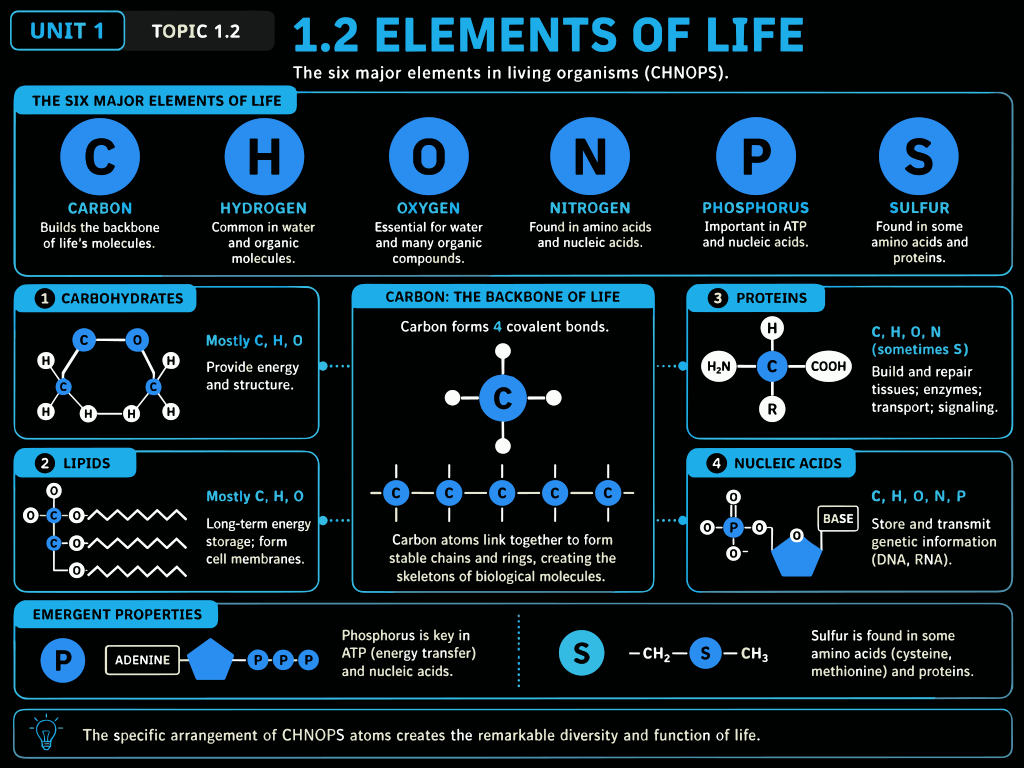
Living things are made of ordinary atoms, but not all atoms in equal measure. Just six elements make up roughly 97% of the mass of a typical cell, and they are easy to remember by the acronym CHNOPS: Carbon, Hydrogen, Nitrogen, Oxygen, Phosphorus, and Sulfur.
It is tempting to shorten the list to just carbon, hydrogen, and oxygen — those three dominate carbohydrates and fats. But that leaves out the two elements that quietly do the most distinctive work. Nitrogen is in every amino acid (and therefore every protein) and in the bases of DNA and RNA. Phosphorus is a minor element by mass, yet it builds the backbones of DNA and RNA, the energy currency ATP, and the phosphate heads of the phospholipids that form every membrane. Overlooking N and P is the single most common way to get the elements of life wrong.
Notice what is not on the list: sodium, chlorine, potassium, iron, calcium, magnesium. These matter for life — nerves, bones, oxygen transport — but they are trace or structural players, not the bulk building material. The molecules that are life — carbohydrates, lipids, proteins, nucleic acids — are assembled almost entirely from CHNOPS.
§2
Why carbon is the backbone of life.
▸
Of the CHNOPS six, one element does something the others cannot. A carbon atom has four valence electrons, so it forms four stable covalent bonds at once. That single fact is the reason life's molecules are so varied.
- Four bonds means four directions. With four bonds, a carbon atom can link to as many as four other atoms — other carbons, hydrogens, oxygens, nitrogens. It sits at the center of its own little scaffold rather than at the end of a chain.
- Carbon bonds to carbon. Because carbon readily bonds to other carbon atoms, those scaffolds link into long chains, branched trees, and closed rings. This is what a “carbon skeleton” means: a framework of carbon atoms that everything else hangs off of.
- Skeletons come in endless shapes. Straight chains, branches, single rings, fused rings, single and double bonds — the same handful of atoms can be arranged in a staggering number of ways. That combinatorial freedom is why carbohydrates, lipids, proteins, and nucleic acids can all be built from the same short element list.
Contrast this with an element like sodium, which tends to lose an electron and become an ion rather than share four bonds. Carbon does not gain or lose electrons to form ions; it shares them, four at a time, and that sharing is what lets it build the large, stable, information-rich molecules that life depends on. Carbon is not special because it is heavy or abundant — it is the versatility of its four covalent bonds that makes it the backbone of life.
§3
The terms you'll meet.
▸
Quick reference card. A functional group is a small cluster of atoms attached to a carbon skeleton that gives the molecule a characteristic chemical behavior.
§4
Functional groups: where the chemistry happens.
▸
A carbon skeleton by itself is fairly unreactive — it is the frame. What decides how a molecule behaves is the set of functional groups hanging off that frame: small clusters of atoms that carry a characteristic chemistry wherever they go. Take two molecules with the identical carbon skeleton, swap the functional group, and you get two molecules that behave completely differently. The skeleton is the frame; the groups set the behavior.
Hydroxyl (–OH): polarity and solubility. A hydroxyl group is polar, so it hydrogen-bonds with water and makes its molecule more soluble. This is why sugars, which are studded with –OH groups, dissolve so readily. A hydroxyl is polar but it is not acidic — it does not readily release an H+.
Carboxyl (–COOH): acidity. A carboxyl group tends to donate a hydrogen ion (H+) in solution, which makes it an acid. Every amino acid and every fatty acid carries a carboxyl group — that is literally the “acid” in their names.
Amino (–NH2): basicity. An amino group does the opposite: it accepts a hydrogen ion and becomes positively charged, so it acts as a base. Because an amino acid carries both a carboxyl (acidic) and an amino (basic) group, it can behave as either an acid or a base depending on its surroundings.
Phosphate (–PO4): charge and energy. A phosphate group carries negative charge and is the reactive heart of some of biology's most important molecules — the backbone of DNA and RNA, the energy-releasing bonds of ATP, and the charged heads of the phospholipids that build membranes. It is a vivid case of a functional group punching far above the weight of the element that anchors it.
Structure → function. Predicting behavior from structure is a habit worth building: spot the functional groups first. Polar groups (hydroxyl, phosphate) raise water solubility; carboxyl means acidic; amino means basic. Same carbon skeleton, different functional groups, different chemistry — that is the whole logic of Topic 1.2.
§5
3 mistakes that cost real points.
▸
“Organic means natural, healthy, or grown without chemicals.”
In biology, organic is a structural label: it means carbon-based — built on a skeleton of carbon atoms, usually with C–H bonds. It has nothing to do with the grocery-store sense of natural, pesticide-free, or healthy, and nothing to do with whether the molecule came from a living thing. Methane (CH4) is organic; table salt (NaCl) is not, no matter how “natural” a mineral it is. Organic molecules can be, and routinely are, made in a lab.
Fix. Ask one question: does the molecule have a carbon skeleton with C–H bonds? If yes, it is organic. “Natural,” “healthy,” and “from a living thing” are irrelevant to the definition.
“Same carbon skeleton means same molecule — the functional groups are just decoration.”
The functional groups are where the chemistry lives, not decoration. Two molecules can share an identical carbon skeleton and behave completely differently: one with a carboxyl group is acidic, one with a hydroxyl group is polar but not acidic, and one with a polar group dissolves in water while a nonpolar version does not. Counting carbons alone tells you almost nothing about how a molecule will act.
Fix. Read the groups, not just the skeleton. Carboxyl (–COOH) → acidic; amino (–NH2) → basic; hydroxyl (–OH) and phosphate → polar/soluble. The group predicts the behavior.
“The elements of life are just carbon, hydrogen, and oxygen.”
Shortening CHNOPS to CHO drops the two elements that do the most distinctive work. Nitrogen is in every amino acid and every nucleotide base; leave it out and you have no proteins and no DNA. Phosphorus is small by mass but builds the DNA/RNA backbone, ATP, and every membrane's phospholipids. Both are easy to forget precisely because they are less abundant than C, H, and O.
Fix. Memorize the full acronym — C, H, N, O, P, S — and remember why N and P earn their spots: nitrogen for proteins and nucleic acids, phosphorus for nucleic acids, ATP, and membranes.
§6
Skill Check.
▸
Ten scenarios. Pick the chips that match your answer, then check. A scenario marks complete the first time every part is right. Progress saves on this device.