 Mistake Master
Structure of water and hydrogen bonding
Almost every property that makes water fit for life traces back to one fact: the water molecule is bent and polar. That single shape lets water molecules cling to each other through hydrogen bonds, and from that clinging emerge cohesion, surface tension, a huge heat capacity, and ice that floats. Get the shape and the bonding straight, and the rest follows.
§1
Why a water molecule is polar.
▸
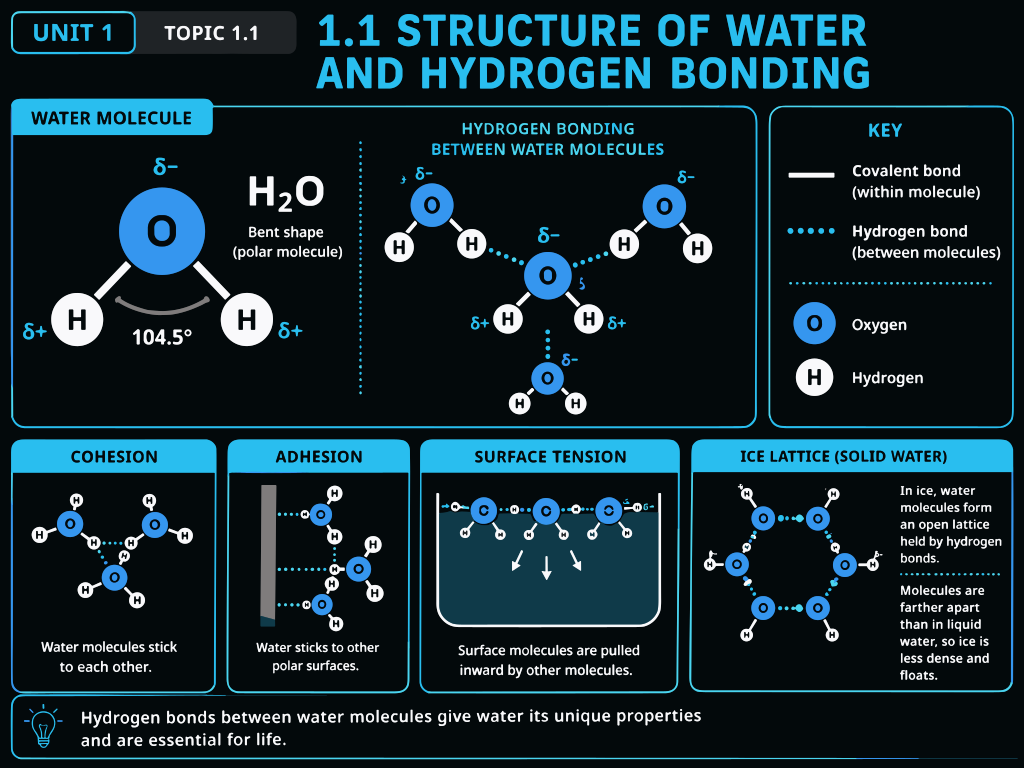
A water molecule is one oxygen atom bonded to two hydrogen atoms, but it is not a straight line. The two O–H bonds meet at the oxygen at an angle of about 104.5°, so the molecule is bent, like a wide V with oxygen at the point.
Inside each O–H bond the two atoms share electrons, but they do not share them evenly. Oxygen pulls the shared electrons much harder than hydrogen does, so the electrons spend more time near the oxygen. That leaves the oxygen end slightly negative (written δ−) and each hydrogen end slightly positive (δ+). Unequal sharing like this is what makes a bond polar.
Here is the part students miss: unequal sharing alone is not enough. Because the molecule is bent, the two bond dipoles point the same general direction and add up to one net dipole across the whole molecule. If water were linear and symmetric, those two pulls would cancel and the molecule would be nonpolar. It is the combination of unequal sharing and a bent shape that gives water a permanent, lopsided charge — a molecular magnet with a negative end and a positive end.
§2
Two very different bonds: covalent vs. hydrogen.
▸
This is the single most important distinction in the whole topic, and the one that trips up the most students. There are two kinds of attraction in the picture above, and they are not the same thing.
- The covalent O–H bond — inside one molecule. This is the intramolecular bond that holds a single water molecule together: oxygen and hydrogen sharing electrons. It is strong. It is not broken when water boils or freezes.
- The hydrogen bond — between separate molecules. This is the intermolecular attraction between the δ+ hydrogen of one water molecule and the δ− oxygen of a different water molecule. Any one hydrogen bond is weak — far weaker than a covalent bond — and it breaks and reforms constantly in liquid water.
Two warnings. First, a “hydrogen bond” is not just any bond containing a hydrogen atom — the covalent O–H bond contains hydrogen and is not a hydrogen bond. Second, when water boils, it is the weak hydrogen bonds between molecules that break so molecules can fly apart as vapor; the covalent O–H bonds stay intact, which is why steam is still H2O. Keep “inside = strong covalent” and “between = weak hydrogen bond” straight and most Unit 1 water traps fall apart.
§3
The terms you'll meet.
▸
Quick reference card. Keep straight what happens inside a molecule versus between molecules.
§4
Emergent properties: the network, not one bond.
▸
Every “special” property of water comes from the same source: many weak hydrogen bonds acting together. No single hydrogen bond is strong — the power is in the collective network. This is what “emergent” means: the property belongs to the whole, not to any one bond.
Cohesion and surface tension. Because water molecules hydrogen-bond to each other, they stick together (cohesion). At the surface, molecules bond to their neighbors and form a taut film — surface tension — strong enough that a water strider can stand on a pond. It is not one strong bond under each leg; it is the whole surface network.
Adhesion and capillary action. Water also hydrogen-bonds to other polar surfaces (adhesion). Adhesion to the walls of a plant's narrow vessels, plus cohesion pulling the water column along, lets water climb upward against gravity — capillary action.
High specific heat. When you heat water, the energy first goes into loosening the huge web of hydrogen bonds between molecules before it can speed the molecules up. So water's temperature rises slowly and it resists temperature change — it can absorb a lot of heat for a small change in temperature. (The covalent O–H bonds are not what absorbs this heat.)
Why ice floats. As water freezes, each molecule locks into a rigid, open hydrogen-bonded lattice that holds molecules farther apart than they sit in liquid water. More space per molecule means lower density, so solid water floats on liquid water. Water is the exception to the usual rule that solids are denser than their liquids — and it is why a pond freezes from the top down, leaving life alive beneath the ice. The same expansion is why a sealed can bursts in the freezer.
Structure → function: the universal solvent. Because water is polar, its partial charges surround and pull apart the ions and other polar substances they meet — the δ− oxygen tugs at positive ions, the δ+ hydrogens at negative ions. That is why water dissolves salts like NaCl and countless polar biological molecules, making it the universal solvent of living cells. Change the structure — make water nonpolar or straighten it out — and every one of these functions disappears.
§5
3 mistakes that cost real points.
▸
“The bonds inside and between water molecules are the same thing.”
The O–H bonds inside a molecule are strong, polar covalent bonds. The attractions between molecules are weak hydrogen bonds. They are different bonds with wildly different strengths. And a “hydrogen bond” is not simply any bond that contains a hydrogen atom — the covalent O–H bond contains hydrogen but is not a hydrogen bond.
Fix. Say it every time: inside = covalent (strong), between = hydrogen bond (weak). When water boils, only the weak hydrogen bonds break; the covalent bonds — and the H2O molecules — survive.
“Water is polar because of unequal sharing alone” (or it's symmetric, so it's nonpolar).
Unequal electron sharing is only half the story. Water is polar because it is both unequally sharing electrons and bent. The bent shape is what keeps the two bond dipoles from canceling. If water were linear and symmetric, the pulls would cancel and it would be nonpolar — like carbon dioxide.
Fix. Check two things before calling a molecule polar: does one atom pull electrons harder, and does the shape leave the pulls uncanceled? Water passes both. Its ~104.5° bend is the reason.
“One strong hydrogen bond explains water's special behavior.”
A single hydrogen bond is weak. Surface tension, high specific heat, capillary rise, and floating ice are emergent — they come from the collective network of many weak bonds, not from one powerful bond. Blaming any one bond for holding up a water strider or resisting heat gets the mechanism exactly backward.
Fix. Whenever a question asks “why does water do X,” reach for the collective hydrogen-bond network, not a single strong bond. The whole is what matters.
§6
Skill Check.
▸
Ten scenarios. Pick the chips that match your answer, then check. A scenario marks complete the first time every part is right. Progress saves on this device.