
Environmental Impacts on Enzyme Function
▶︎ Watch it animatedinteractive step-through · ~3 min · optionalAn enzyme works because it is folded into a precise shape — and that shape is fragile. It holds only under the conditions the enzyme evolved in, so the environment around an enzyme, not just its structure, decides how fast it works. Change the temperature or the pH, and you change the rate. Push those conditions far enough and you don't just slow the enzyme down — you break the fold that made it an enzyme at all.
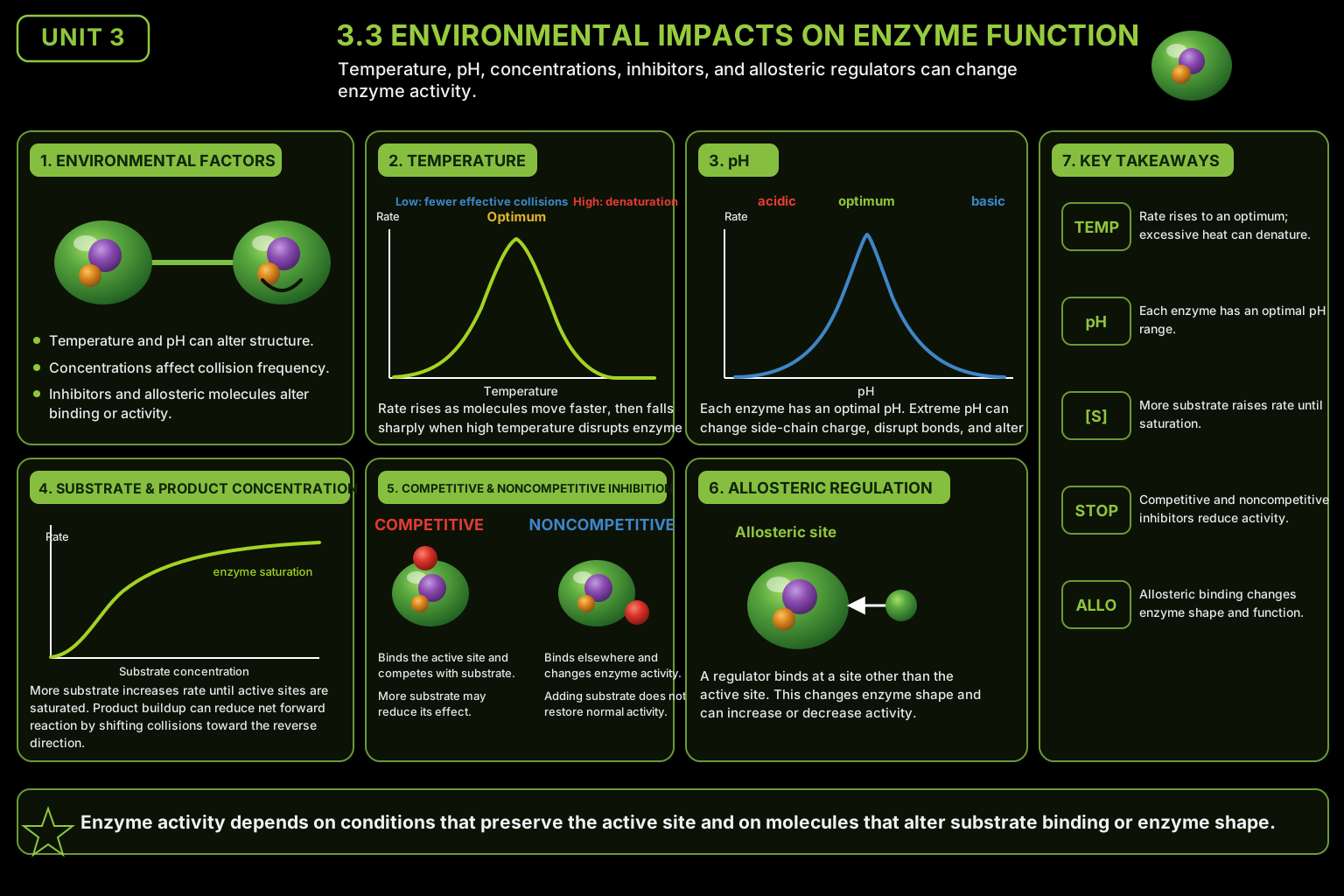
Every enzyme has an optimum: a temperature and a pH at which it runs fastest. Warming a cold solution speeds things up at first, because molecules collide more often and more forcefully. But past the optimum the curve turns and drops sharply — the added heat now shakes the protein apart faster than it helps the reaction. The pH story is the same shape: too acidic or too basic on either side of the optimum, and activity falls away. Human enzymes peak near body temperature and near neutral pH; a stomach enzyme peaks in acid. There is no single "best" setting — only the best setting for that enzyme.
Key ideas
- Every enzyme has a temperature optimum and a pH optimum — the conditions where it works fastest. Move away from either one, on either side, and activity falls.
- More heat is not always faster. Rate rises with temperature only up to the optimum; past it the curve turns and drops sharply as the enzyme denatures. "Hotter" stops meaning "faster."
- Denaturation disrupts the fold, not the backbone. Heat and extreme pH unravel the enzyme's three-dimensional shape, so the active site no longer fits its substrate — but the peptide bonds along the chain stay intact. The protein is unfolded, not chopped up.
The mistakes here all come from forgetting that conditions have two sides. One is treating an enzyme as a reusable catalyst but ignoring that it can be wrecked by its surroundings — a denatured enzyme is not reusable, even though an intact one is (U3-BIO1). Another is assuming more heat always means a faster reaction, missing the turn past the optimum where denaturation takes over (U3-BIO7). And the deepest one is imagining that denaturation breaks the peptide bonds — chopping the protein into pieces — when it only unfolds the shape and leaves the backbone whole (U3-BIO8). Every scenario in this topic asks you to read a change in the environment and predict what it does to the rate — and to the enzyme.
The work
3 ways in · any order
Lesson
Environmental Impacts on Enzyme Function
›
Temperature and pH set how fast an enzyme runs — up to a point. The lesson walks the ways students misread those conditions: that hotter is always faster, that a denatured enzyme is still reusable, and that denaturation shreds the protein rather than merely unfolding it. Ten scenarios ask you to reason from a change in the environment to what happens to the rate and to the enzyme's fold.
Diagnostic
10-item topic check
›
Ten items on how the environment shapes enzyme activity — that a denatured enzyme is not the reusable catalyst an intact one is (U3-BIO1); that more heat speeds a reaction only up to the optimum, not past it (U3-BIO7); and that denaturation unfolds the enzyme's shape without breaking its peptide backbone (U3-BIO8). Take it cold to surface which of these are still tangled, or after the lesson to confirm they hold.
Targeted Practice
Drill a single misconception
›
Pick one of the failure modes you missed and drill it on its own. The round is adaptive: two correct in a row clears the misconception and moves you to the next.