
Enzyme Catalysis
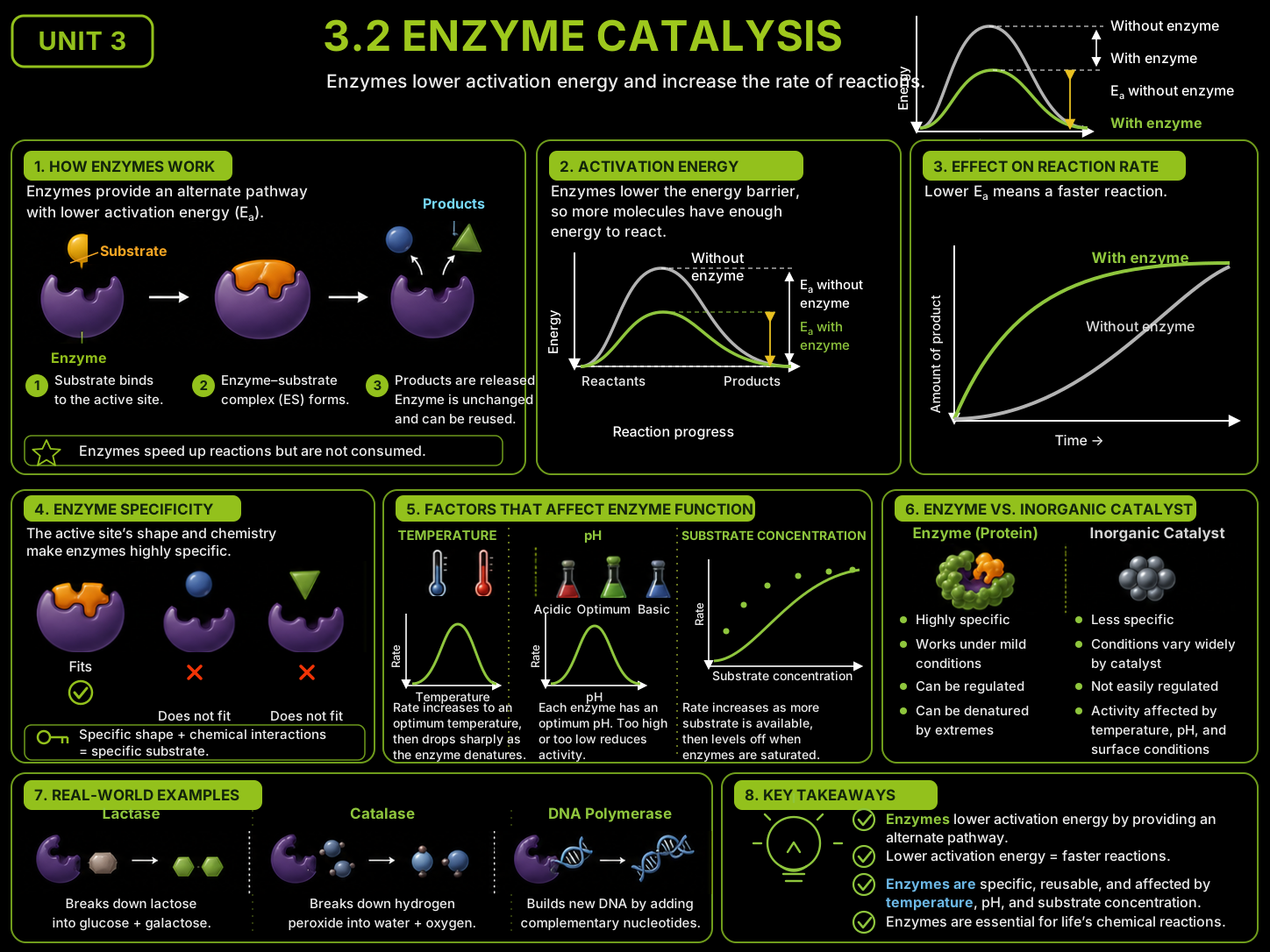
▶︎ Watch it animatedinteractive step-through · ~3 min · optionalEvery reaction that could happen in a cell has to climb a hill first. Before reactants can become products, their bonds must be strained and rearranged through a high-energy, unstable transition state — and the size of that hill, the activation energy, is what decides how fast the reaction goes. Most cellular reactions are thermodynamically favorable yet crawl along far too slowly to sustain life, because that activation barrier is too tall to cross at body temperature. An enzyme's whole job is to lower it.
An enzyme catalyzes a reaction by binding its substrate in the active site and stabilizing the transition state, so the barrier the reaction must cross is smaller and far more molecules make it over per second. Crucially, the enzyme changes only the path, not the destination. It does not push an unfavorable reaction uphill, it does not add energy to the products, and it comes out the other side unchanged — a catalyst is reused again and again. The energy that drives the reaction was already in the reactants; the enzyme just makes it easier to release.
Key ideas
- lowers barrier An enzyme speeds a reaction by lowering its activation energy — stabilizing the transition state so many more molecules cross the barrier each second. It does not heat the reactants or supply a push.
- ΔG unchanged An enzyme never changes a reaction's ΔG or its equilibrium. The reactant and product energy levels stay put, so an enzyme cannot make an unfavorable reaction favorable — it only lets the favorable one get there faster.
- energy from reactants The energy released comes from the reactants themselves, not from the enzyme. The enzyme is a facilitator, not a fuel source.
- reusable A catalyst emerges unchanged and reusable. A single enzyme molecule turns over the same reaction again and again; it is not consumed and is not part of the product.
The mistakes here all confuse what a catalyst does with what it can't do. One is thinking an enzyme is consumed in the reaction — but a catalyst emerges intact and reusable (U3-BIO1). Another is believing the enzyme changes the reaction's ΔG or equilibrium, or that lowering activation energy can drive an unfavorable reaction uphill — it can't; it only speeds a reaction that was already favorable (U3-BIO5). And the third is imagining the energy released comes from the enzyme rather than from the reactants, treating the catalyst as a fuel source instead of a facilitator (U3-BIO6). Every scenario in this topic asks you to reason from what a catalyst actually is to what it can and cannot change.
The work
3 ways in · any order
Lesson
Enzyme Catalysis
›
Catalysis is where students most often mix up speed with direction. The lesson walks the ways that reasoning breaks down: treating the enzyme as consumed, believing it changes a reaction's ΔG or equilibrium, and imagining the released energy comes from the enzyme rather than the reactants. Ten scenarios ask you to separate what a catalyst speeds up from what it can never change.
Diagnostic
10-item topic check
›
Ten items on enzyme catalysis — that enzymes are reusable catalysts, not consumed (U3-BIO1); that lowering activation energy never changes a reaction's ΔG or equilibrium (U3-BIO5); and that the energy released comes from the reactants rather than from the enzyme (U3-BIO6). Take it cold to surface which of these are still tangled, or after the lesson to confirm they hold.
Targeted Practice
Drill a single misconception
›
Pick one of the failure modes you missed and drill it on its own. The round is adaptive: two correct in a row clears the misconception and moves you to the next.