 Mistake Master
Enzyme structure
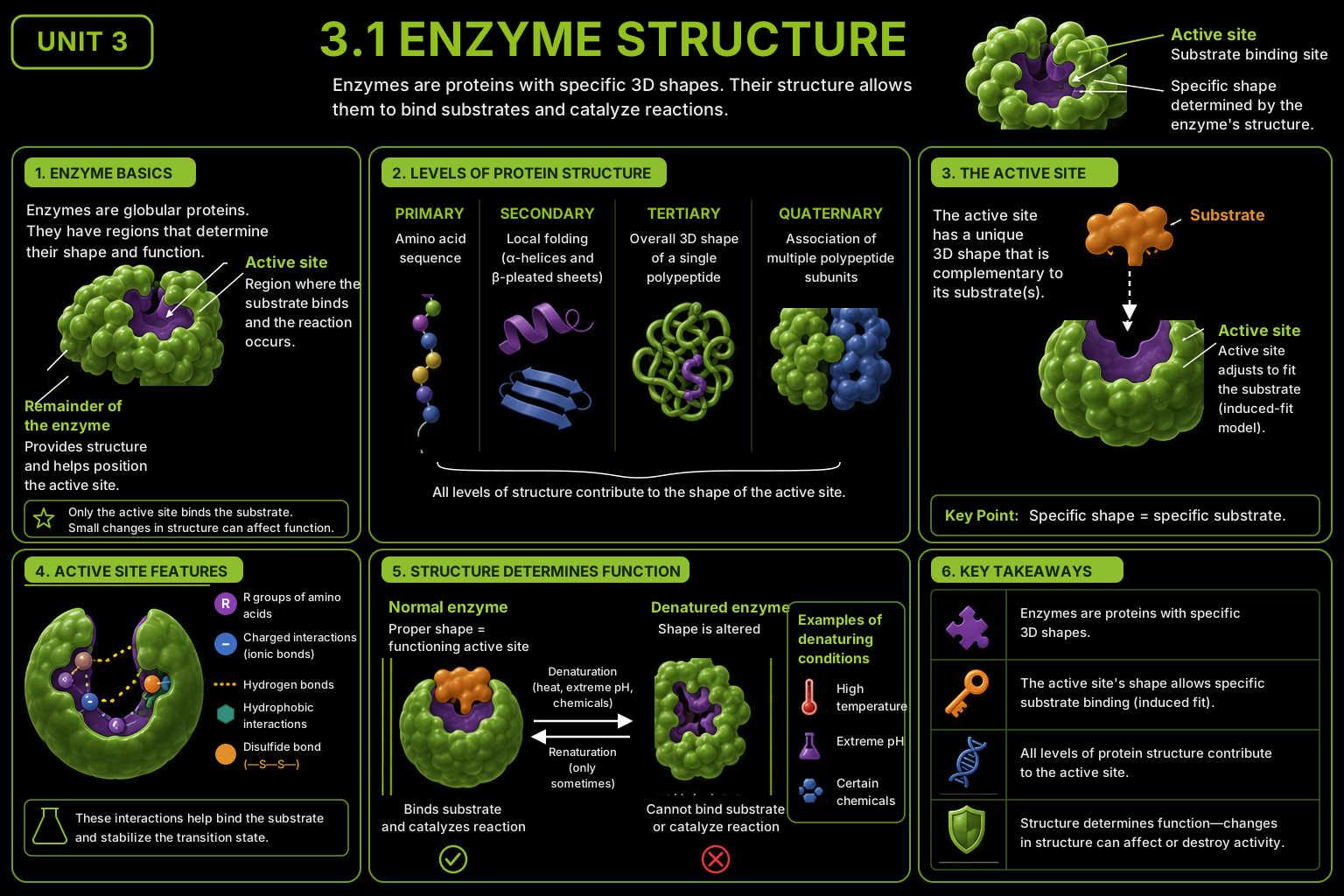
An enzyme is a protein that speeds up a reaction without being used up. The secret is a small pocket called the active site, shaped to grip one particular substrate. But the fit is not a rigid lock and key — as the substrate binds, the active site molds around it, an adjustment called induced fit. When the reaction finishes, the enzyme lets its product go and emerges completely unchanged, ready to do the same job again and again.
§1
The one big idea: enzymes are reusable catalysts.
▸
An enzyme is a biological catalyst — almost always a protein — that speeds up a chemical reaction. The single most important thing to understand is what a catalyst is: it makes a reaction happen faster without being consumed by it. The enzyme guides the reaction, then comes out the other side chemically unchanged, ready to do the exact same thing again.
That means an enzyme is not a reactant. It does not get “used up,” it is not converted into product, and it does not run out after one reaction. A single enzyme molecule can process thousands of substrate molecules per second, over and over. If you ever picture an enzyme being spent or destroyed as it works, you have the central idea backward.
Everything else in this topic follows from that catalytic role: where the reaction happens (a specific pocket called the active site), which reaction each enzyme speeds up (substrate specificity), and how the enzyme grips its substrate (induced fit). Keep the reusable-catalyst picture in mind and the rest of the topic clicks into place.
§2
The active site and substrate specificity.
▸
An enzyme does its work at one small region, not across its whole surface. Here are the parts and terms you need.
- Active site — the working pocket. A small groove or pocket on the enzyme, formed by the way the protein folds. This is where catalysis happens. Its precise 3-D shape and its chemistry (the arrangement of specific amino acid side chains) are what make an enzyme an enzyme.
- Substrate — what the enzyme acts on. The reactant molecule (or molecules) that binds in the active site. The enzyme holds the substrate and lowers the barrier to its reaction, converting it into product.
- Specificity — one enzyme, one job. Because the active site has a particular shape and chemistry, only a substrate that complements it will bind well. That is why each enzyme typically catalyzes just one reaction, or one narrow class of reactions — sucrase acts on sucrose, not on lactose or maltose.
- Enzyme–substrate complex — the moment of binding. When the substrate settles into the active site, the two form a temporary enzyme–substrate complex. This close, oriented contact is what lets the enzyme strain bonds and speed the reaction.
- Product — and release. Once the reaction is done, the product no longer fits the active site snugly, so it drifts away. The active site is now empty and its original shape returns — the enzyme is ready for the next substrate.
Notice the through-line: it is the shape and chemistry of the active site that decides which substrate binds and which reaction is sped up. Specificity is not a preference — it is a physical match.
§3
The terms you'll meet.
▸
Quick reference card. For each term, read the structure and the role it plays — the shape-to-job match is the whole game.
§4
Induced fit: the active site molds to the substrate.
▸
The oldest way to picture enzyme binding is “lock and key”: the substrate (key) slots into a rigid active site (lock) of exactly matching shape. That image gets one thing right — the match is specific — but it is misleading in an important way. The active site is not a hard, fixed cavity.
Induced fit is the accurate model. When the substrate begins to bind, the active site changes shape, wrapping and tightening around the substrate to grip it more snugly. The enzyme is flexible; binding induces the final, best-fitting shape. Think less of a metal key in a metal lock and more of a hand closing around a ball, or a glove conforming to a hand.
Why the molding matters. That adjustment does real chemical work. By clamping down and reorienting the substrate, the active site strains and stresses the substrate's bonds and lines up the reacting groups just so — which is exactly how the enzyme lowers the activation energy and speeds the reaction. A rigid pocket that merely held the substrate still could not do that. The flexibility is a feature, not a flaw.
Specificity is still strict. Induced fit does not mean the active site is loose or accepts anything. The substrate must already be a close chemical and geometric complement for binding to trigger the molding at all. A molecule of the wrong shape or chemistry never induces the fit and is not catalyzed. Flexible, yes; indiscriminate, no.
And the enzyme resets. After the reaction, the product is released and the active site relaxes back to its original resting shape. Nothing about the enzyme was permanently altered — the same molecule binds the next substrate and repeats the cycle. Reusability and induced fit are two sides of the same catalytic story.
§5
3 mistakes that cost real points.
▸
“The enzyme gets used up in the reaction.”
This is the most common enzyme error (code U3-BIO1). Students imagine the enzyme is consumed like a reactant — converted into product, worn out, or used up one reaction at a time. It is not. A catalyst is defined by not being consumed: the enzyme binds substrate, speeds the reaction, releases product, and comes out chemically identical. One molecule can catalyze the same reaction thousands of times.
Fix. Write the enzyme on both sides of the arrow, or better, above it — it is a catalyst, not a reactant. If your account has the enzyme disappearing or running out per reaction, it is wrong.
“Binding is a rigid lock and key — the active site never changes shape.”
The lock-and-key image (code U3-BIO3) treats the active site as a hard, fixed cavity that the substrate simply slots into. That misses how enzymes actually work. The active site is flexible: as the substrate binds, it molds around it — induced fit. That reshaping is what strains the substrate's bonds and lowers the activation energy. A truly rigid site could hold the substrate but couldn't do the catalytic work.
Fix. Picture a hand closing around a ball, not a key in a lock. The fit is real and specific, but it is achieved by molding, and the site relaxes back afterward.
“Since active sites flex, any substrate can fit any enzyme.”
Students who learn about induced fit sometimes over-correct (code U3-BIO4), concluding that the active site will just bend to accept whatever shows up. It won't. Induced fit is triggered only by a substrate that is already a close chemical and geometric complement; a molecule of the wrong shape or chemistry never binds and is never catalyzed. Each enzyme stays highly specific — one enzyme, essentially one reaction.
Fix. Hold two ideas at once: the site is flexible and selective. Flexibility fine-tunes the grip on the right substrate; it does not open the door to the wrong one.
§6
Skill Check.
▸
Ten scenarios. Pick the chips that match your answer, then check. A scenario marks complete the first time every part is right. Progress saves on this device.